Monday, February 8, 2016

Zika Virus and Genetically Engineered Mosquitoes

The Zika virus has been dominating the news lately and I am sure you may have already heard enough.  However there were a couple of topics I wanted to blog on this week.

1.  Some rumors are spreading on the internet (image that!) which actually say Genetically Modified (GM) mosquitoes caused the Zika Outbreak

2.  Secondly, should we be genetically modifying mosquitoes?  I have my own thoughts on this and wanted to pose a couple of questions before you answer that question for yourself. 


https://en.wikipedia.org/wiki/Mosquito#/media/File:Aedes_aegypti.jpg


Genetically modified mosquitoes did not cause the outbreak!

We can start the story with a quick recap.  Zika is a virus spread by mosquito, specifically the Aedes aegypti mosquito.  The symptoms of the disease are quite mild.   You can develop a fever, rash, joint pain and conjunctivitis that may last for 2-7 days.   In some cases someone with Zika virus may not even know they have it due to the mild symptoms. The virus was first identified in 1947, but it is now making headlines because of a very large outbreak in Brazil that started in 2015.  Since that outbreak, a large number of babies born with microcephaly has been on the rise.  Microcephaly is when the baby has a smaller than normal head due to incomplete brain development.  While an adult suffering from Zika is a non-issue, babies born with micorcephaly is a very large problemfor obvious reasons.  There is still no definitive science that has shown Zika is the cause of microcephaly, but the correlation is strong and the main assumption at this point.  Lots of research is going into this area and if you want more info on the ongoing science take a look at this scientific paper:  http://www.cdc.gov/mmwr/volumes/65/wr/mm6503e2.htm

The second part of the story is that there is a company called Oxitec that has genetically modified mosquitoes that they hope will help reduce dengue disease.  The mosquitoes being targeted are Aedes aegypti since they are the specis that carry dengue, but also happen to the the same species of mosquito that carry the Zika virus.  That is good news because the Oxitec technology could help with Zika.   Oxitec conducted a trial with these mosquitoes in 2011 in one Brazilian city and the trail was an overwhelming success.   The local population of Aedes aegypti mosquitoes were reduced 90%.  

The technology behind Oxitec's GM mosquitoes is very exciting.  I encourage you to go to their site and read about it.  Here is an excerpt from the site http://www.oxitec.com/ that really goes into detail on how the mosquito are made:  Keep in mind only the non-biting males are engineered.


Finally the two stories come together when social media decided to spread a rumor just likes its own virus.  Headlines, Facebook posts, and Twitter posts were ablaze with false information that the reason we have the Zika outbreak in Brazil is because of these GM mosquitoes.  


The claims are a complete joke, but you probably saw the headlines somewhere and our brains are quick to say "Hey that might make sense."  We really need to look at where the claims are coming from and the science to debunk it, something that requires extra work.  The rumor started because a Reddit post showed the outbreak location in Brazil was close to the Oxitec GM trials.  That post ballooned into GM mosquitoes caused the outbreak.  When we look at the facts the locations pinpointed are actually far away from the outbreak.  The other big debunking fact is that the Brazilian Zika outbreak occurred in 2015 and can be traced to other outbreaks, while the Oxitec trials were four years earlier.   For the detailed facts check out this article:  http://www.theguardian.com/world/2016/feb/04/alert-theres-a-dangerous-new-viral-outbreak-zika-conspiracy-theories

Even Snopes, a site that facts checks rumors commented on this one:  http://www.snopes.com/zika-virus-gmo-mosquitoes/

http://www.snopes.com/zika-virus-gmo-mosquitoes/


The rumors once again make GM technology seem like an evil thing.  In this case the critics are spreading fear and that fear can spook regulators.  Regulation is supposed be science based, but that is not always the case.  Every delay is causing more Zika virus to spread and if it is truly causing microcephaly, then every delay is also causing human hardship even though we have the tools to fight. 


Should we even genetically modify mosquitoes?

Let's start with  the fact that  manipulating insects is not a new thought.  There is another insect called the screwworm (don't eat before Googling that one).  The screwworm fly lays eggs in a wound and the screwworm larvae hatch and "drill" down in the wound and eat the flesh.  Cattle are affected the most, but they can affect other animals.   The screwworm can of course cause death and was major problem in the Americas.   To gross you out more, the worms can affect humans as well.  The economic impact from cattle losses was so large that a facility in Panama was built to constantly rear screwworms flys, irradiate them to sterility and release them by airplane.  There are so many sterile flies that any normal female only meets a non-sterile fly and the population stays low.  This operation never stops and employs about 400 people with a budget of 14 million per year (2014 data).  That is very little money and resources compared to the billions of dollars in losses to farmers if the fly was still around.   So manipulating an insect is not a brand new though or technology.  We have been doing it since the 50s when the screwworm fly program was first started.

I know this can be an ethical question for some.  How could we eradicate a bug even if it is a mosquito.  What are the environmental impacts?  Don't worry about eradicating all mosquitoes with this technology.    There are 3500 species of mosquitoes and only a very small number of that transit disease to humans.   Any technology is going to be very targeted and only used to help people. 

The fact remains that we have a tool to save lives and reduce disease.  Before you make your final judgement run these scenarios in your head.

1.   There are no Zika carying mosquitoes around me.  Should we release genetically modified mosquitoes?

Now ask this one:

2.  My daughter is pregnant and my neighbor was just diagnosed with Zika virus.   Should we release genetically modified mosquitoes?

For me the answer is pretty straight forward.  I value human life and the science has shown that the technology is safe.  I am heartbroken from the images of crying moms in Brazil and ready to put science to work to solve some of our world problems.  Don't let good science and the potential to save lives be delayed because of something you have not verified on social media or word of mouth from a friend.




Monday, January 25, 2016

GMOs cause allergies: More false propaganda

I hear one concern about GMOs more than most and it is a concern that also comes up on surveys about why people are scared of GMOs.   People are fearful that they will be allergic to GMOs.   This Frankenfood has foreign DNA that is going to be harmful if you eat it.   I don't want to get off topic, but I want to clarify one thing. When two cultivars of the same crop species are crossed there is foreign DNA being introduced as two different plants combine DNA to make a new plant that is genetically different from its parents.   I know the argument then shifts to "well there is DNA from another species in my food with many GMOs."  I have a couple blog posts already showing that in nature foreign DNA from other species is being incorporated in plants,w including in foods we eat now like sweet potatoes.

But lets get back to allergies.   The GM plant is now making a new protein and so I might be allergic to GMOs.   It is true that food allergies come from proteins and biotech companies are well aware of allergen risks.  However if you read any anti-GMO propaganda you will quickly believe that allergens in GMOs are all over the place.  Again the fear mongering without the facts is rampant on the internet. Just one quick Google search and this was the first thing that pops up for me.

https://www.organicconsumers.org/old_articles/ge/allergies111603.php

Read this and you would think biotech companies are just carelessly putting products on the market.   Most of the proteins "have never been ......tested for their safety"   Really!!  Wow.  These lies are why the public has such a misconception of GMOs.  The FIRST thing a a company does in the early research is run any new protein against a database of known allergens.  If it is even remotely a hit the protein is dropped.  Secondly a new product takes 10-15 years to reach the market.  Agronomic testing and breeding multiple generations to get the final seed is part of that long timeline, but regulatory and safety testing is the other reason.  Any new product goes through a lot of testing to ensure the new protein is safe.

Go to http://www.allergenonline.com/ and dig around there for a bit.   This is a database maintained by the University of Lincoln-Nebraska and contains peer reviewed sequences of allergens.   There is so much science to make sure allergens are a non-issue in any GMO product.   This is a great database and not even the only one that will be used in an allergen cross-reference.

Here is an excerpt from an article on the same topic. When you get a chance check the entire article out at https://www.geneticliteracyproject.org/2014/04/16/are-gmos-causing-an-increase-in-allergies/


I have heard of people saying they cut out GMOs and all of a sudden there allergies were cured.   In the US, 90% of allergies come from peanuts, tree nuts, milk, eggs, wheat, soy, shellfish, and fish.   If you want to see what GM crops are approved then check out this nice resource:  http://www.isaaa.org/gmapprovaldatabase/.  The only GMO crop widely available in the US consumer market that is a known source for food allergies is soybean.   Monsanto is working on a wheat variety that will be resistance to Round-Up but it is limited in availability at this time.  So most of the allergy inducing foods out there aren't even GMO to begin with.

The GM varieties that are on the market are scrupulously tested for allergen hits before release.    In fact some I would wager that GM crops are tested more for allergens than many "non-GM" foods that have been introduced in the US.  Now I love Kiwi's, but they were not tested for allergens when introduced in the US in 1962.  However, Kiwis can cause serious allergies in some.  For more info on Kiwi allergies take a look at http://allergicliving.com/2010/09/01/serious-fruit-allergy-kiwi/    The fact remains that Kiwi's are not in the headlines as some evil food because it causes allergies.   If you are allergic to a protein in soybean, then you are going to be allergic to it no matter if it is GMO or non-GMO.  And when there is a GMO variety, there are a minor number of protein additions which again have been robustly tested for allergies. Everything else about the plant is the same as any other soybean plant.

The bottom line is I cannot say that no one out there will NEVER be allergic to a new protein from a GMO crop.  However you are more likely to be allergic to something that is already a known allergen than any protein that a biotech company discovers.  If a new protein shares an amino acid sequence (the building blocks of proteins that ultimately comes for a DNA sequence) with an allergen it is not going to be released.  Because of the strict science and knowledge of what causes food allergies in humans, no new protein from a GMO to date has been shown to cause an allergy no matter what the anti-GMO propaganda may say.

http://www.foodallergens.info/Facts/GMO.html


Monday, January 18, 2016

Astrophototography: Bubble Nebula


I think the bubble nebula may be my one of favorite targets to date.  There is just something captivating about a bubble of gas sitting in space. When you throw a rock into a pond you see a ripple travel through the water.  That ripple might even even travel the entire width of the pond.  It boggles my mind to think "ripples" of gas are traveling through the universe, but instead of pond size the ripples are light years in size.    In the case of the bubble nebula a very big star that is 45 times the size of our sun and hundreds of thousands of time brighter, has sent out its own ripple of stellar wind   The star's stellar wind has blown gas from around it, and the gas is contained in a tight bubble by a molecular cloud that happens to be in the same area.  The bubble we see in the picture is actually 10 light years across.

In astrophotography half the battle is taking the photos through the night.   However the other half of the battle is putting all of that data together to get your final picture.  I have tried several programs to get those final images and tend to use Pixinsight and StarTools the most.   The first picture is the final picture using Pixinsight.  It is probably the best representation of the nebula in terms of color, but the StarTools picture turned out decent as well.   These pictures just show that there is a lot of complex interactions going on when you combine 70 two minute exposures.  Every time you combine the data the final result is going to be a little different.


Monday, January 11, 2016

Is antibiotic resistance predictive of stagnic farm production?

So I know the title seems like a stretch.  How are antibiotics and farming even remotely connected and in reality they are not.  However there are correlations I see among both topics that I wanted to explore.

It all started when I was listening to a podcast (Raiolab) and  they were talking about the history of antibiotic resistance. It is a very interesting episode so take a listen:   RadioLab: Staph Retreat  We hear about antibiotic resistance all the time in the news.    MRSA (Methicillin-resistant Staphylococcus aureuscomes to minds as a particular nasty antibiotic resistance bacteria in our hospitals.   Lots of times the term "superbug" is is given to these emerging antibiotic resistant strains.  It is a real problem and so the first question to ask is why are there no more antibiotics coming on the market?

The first antibiotic was discovered in 1928 by Alexander Fleming and was a drug we have all probably taken at one point or another.  I still remember the pink bubble gum flavored penicillin I took as a kid.  With Penicillin the antibiotic revolution was kick started and the media was eating it up.

http://www.nww2m.com/tag/penicillin/

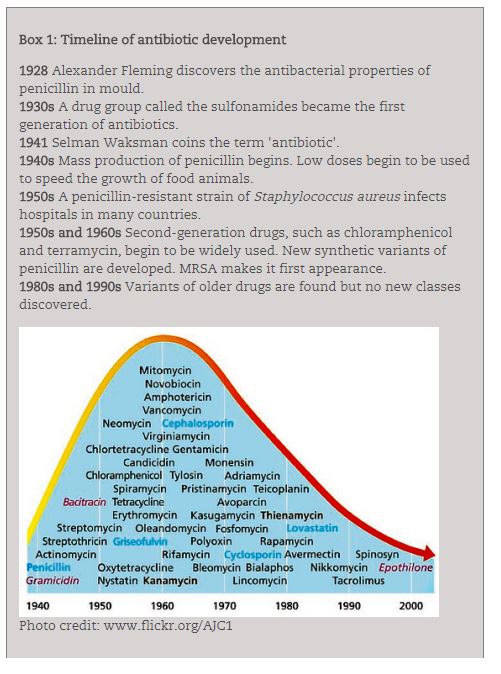
Penicillin was just the first of many antibiotics that  really got going in the 50s and 60s.  At that point there were so many antibiotics coming out that it looked liked we might have an answer for any bacterial infection. The figure below shows the peak of development before development declines.


http://www.scidev.net/global/health/feature/antibiotic-resistance-frequently-asked-questions.html


The other part of the antibiotics story is resistance.  Lots of drugs were coming out, but resistance was developing FAST!  Take a look this figure.


https://agreatcomplexity.wordpress.com/2012/05/05/the-cost-of-resistance-our-current-models-of-antibiotic-research-and-development-are-unsustainable/

Penicillin is introduced in 1941 with some resistance in the 40s.  Streptomycin is introduced in 1944 and resistance comes within a couple years.  Methicillin was introduced in 1952 and resistance was seen in 1960.   This list goes on with the same general trend.  When an antibiotic is developed the bacteria are very good at developing resistance and many times that resistance came 1-3 years after release.    Since the onslaught of new antibiotics in the 50s and 60s, the number of antibiotics have dramatically declined.   There are numerous reasons for this, but as the figure above mentions one of the biggest is that it is not appealing for pharma companies to spend millions on a drug that once released will only be used for a couple years before resistance pops up.    From a business perspective you can't blame them because if they can spend money on a drug that stays on the market for 10-20 years then they can recoup their R&D costs and turn a profit.   However as humankind we all are now suffering from those decisions.  There are very few antibiotics in the R&D pipeline compared to the peak of the 50s and 60s.  We now are live in a world where less new antibiotics are being released and bacteria are continuing to find resistance to what we do have.   As more resistance pops up and antibiotic choices dwindle, I think pharma companies will have to jump back into more R&D. I would predict this move purely on the the model of supply and demand;  especially if these superbugs start causing more and more deaths.  

Now let's jump to agriculture.   I was reading an opinion piece in the New York Times and realized that just like pharma companies not putting money into antibiotic development, the government is not putting money into agricultural development.

http://www.nytimes.com/2016/01/04/opinion/we-need-a-new-green-revolution.html?ref=opinion&_r=2

So we went from 40% of American research towards agriculture in the 1940s to only 2% today.   Many other countries are also not contributing the needed R&D to keep yields going up.   If you go searching for yield gains for crops you will see increases.  However in many cases these increases are coming from private biotech or the fact we are just planting on more land!.

Examples of the impact of a private biotech trait on yield are seen in Bt and herbicides.


http://grist.org/food/why-gmos-do-matter-and-even-more-to-the-developing-world/
So while conventional breeding has shown a mostly linear progression of yield increase, there are points in history for several crops where we see what a GMO trait can do.  Of course we also have increases in yield because land use keeps going up as well.


http://www.nature.com/ncomms/2013/131217/ncomms3918/full/ncomms3918.html


Look at how much land use has gone up in the last 10 years.  By using more land it is easy to mask the true issues we face.   Eventually the land will run out, but the population continues to grow exponentially.  The atricle for Nature sums up this point:

http://www.nature.com/ncomms/2013/131217/ncomms3918/full/ncomms3918.html


Our yields are plateauing and there are many reasons for this including "poor investment in agricultural research and development."


This brings us full circle  back to antibiotics.  I think the antibiotic shortage is predictive of the food shortage problem.  We should use the lessons from antibiotics as a warning.  If we are not going to spend the money and resources towards agriculture then instead of "superbugs we will may have a "super shortage."  GMOs are part of the answer, but we have to remember that the private industry is a compliment to academia and government research.    They are spokes on a wheel and without all three working together progress is much slower.   Academia is at a low for grant money received for agricultural research.  .Hopefully the trends will change.  The major symptoms are hidden in both cases.  There are still just enough antibiotics out there to make things seem alright even with the emergence of superbugs here and there.  There is still land to use that makes overalls yields go up each and every year.   If everything is working then why spend money.  Remember that the pipelines for both antibiotics and new crops can take as long as 10-15 years to get a product on the market.   So just throwing money at a problem may have positive effects, but not immediately.

Keep the pressure on the increase research in our universities.  And keep supporting the biotech industries.  They are all part of the effort to help keep everyone fed.  Here is one of many graphics that show the demand for food production is inevitably going to go up.  The question is whether we can keep the yields on pace.

Twitter @Bayer4Crops


Monday, January 4, 2016

What is on your organics? ...Bt for one

The term "GMO" has become tough to define.  For many it is an evil word, while "organics" are what is going to save the day.   I have nothing against organics, but while GMOs have a mixed reactions organics are the golden child that can do no wrong.  Organics have there niche and I am certainly not above buying them.   My biggest problem with organics is that they are very labor intensive and I do not see them as a sustainable option in the long term future as our population continues to expand drastically.   An even more common problem is the lack of information.    I do not think the general population fully understands that organics still receive some chemical treatment.  Just because something is organic does not mean it it was just grown in a field and nothing but pure water and sun ever touched the plants.

Let's take a look at one of the most common GMO products for insect control.   "Bt" corn and soy are widely adopted by farmers and do a great job controlling certain insects.  "Bt" stands for Bacillus thuringiensis.  Yhese bacteria make a natural protein that kills insects.  This is a similar concept to antibiotics.  Bacteria are always competing against each other and nature and thankfully make these compounds to keep them competitive against other organisms  competing in the same spaces.   The gene that produces this protein has been inserted into plants and when insects digest the protein they die.  But guess what?  Bt has been sprayed on plants for years and is allowed on organics because it is a natural protein found in nature.   In fact it accounts for up to 90% or of the organic pest control market (http://www.bt.ucsd.edu/organic_farming.html).   So GMOs are terrible because they have Bt, but Bt spray is fine.  Say what!!??

Here is my augment summed up nicely from http://grist.org/food/slate-anti-gmo-activists-say-the-darnedest-things/


There are also many other things that may be used on organics that you may not be aware of.   Here is the list of things that are allowed by federal regulations in the US:

http://www.ecfr.gov/cgi-bin/text-idx?c=ecfr&SID=9874504b6f1025eb0e6b67cadf9d3b40&rgn=div6&view=text&node=7:3.1.1.9.32.7&idno=7


Check out this article on the same subject.  It is very informative.

https://www.geneticliteracyproject.org/2015/12/07/myth-busting-on-pesticides-despite-demonization-organic-farmers-widely-use-them/


The point here is that insects are a problem and in order for you to have food to eat insects have to be controlled whether you are eating GMOs or organics.  I feel that organics have this reputation that they have absolutely nothing on them.  I understand the appeal of organics and there is some great tasting and quality food coming from organic farms. However, they still still use options to control insects. including Bt that has been an argument for anti-GMO activists for years.  The good news is Bt is safe whether in your GMO or organic food.


Monday, December 21, 2015

Science for kids: Parallel vs Series Circuits

It has been awhile since I last sat down to type, but hopefully I can get back to my rambling.   We are finally getting settled down into a new home and I can start looking at a computer more than boxes!  What a good feeling!

We are heading into Christmas and the holiday period.  So maybe you have some time off work with your  kids or just to be a kid yourself. This is an easy project I did with the scouts a couple weeks ago for one of the Adventures in Science requirements.  The boys had to understand the difference between a Series and Parallel circuit and build each circuit.

There is a very easy way to build these circuits and understand the differences using the following supplies:

1. 2 pieces of paper
2.  Glue and Scissors
3.  Aluminium foil
4.  9 V battery
5. 2 small wattage bulbs:  I used a 6 W indicator bulb, but make sure they are only 12 V bulbs and not      120 V bulbs

Have you been putting up lights on a Christmas tree and one light goes out followed by all the lights going out?  This is a fun project because it will be easy for the kids to grasp why that happens.

Here are the circuits  my son made.  Just cut the aluminum foil into strips and glue them down on the paper.   The foil should be making very good contact with other piece of foil in places where you are connecting pieces so don't use too much glue.   For both the series and the parallel circuit leave a small gap at the top for the 9 V battery.    These circuits are set up to light 2 bulbs at a time.  The pictures below just show 1 bulb lighting up because you need a second person to hold the other bulb and I was being lazy.  .

The series circuit is how many Christmas lights are set up.  Looking at the pictures below you can see that if one light is removed you break the circuit which makes all the lights go out.  Using one light at each of the 2 gaps will make both lights work, but remove one light and they both go out.


The Parallel circuit is better because the circuit is still complete even when one light is removed. The top gap is again for the battery.  Then one light is used for each of the two gaps.  Removing one light will not affect the other light.


In order to make the lights work you need to make a strand of aluminum foil.  The socket part of the light should be wrapped tightly.  The bottom of the light should make contact with the circuit aluminum foil and the opposite end of the foil wrapped around the light should span the gap of the circuit you created and touch the aluminum foil.


To get light, make sure the battery is on the foil where you made a small gap at the top of the circuit.  With the light wrapped with a strand of foil place the light firmly on one side of a gap.  The other end of the strand attached to the light should cross the gap and make contact with the foil.  You can place another bulb at the bottom of the circuit to light two lights at a time.  Play around with removing either light.


The series can be set up the same way. In the picture below I added a "switch" instead of a second light by placing a small piece of foil across the second gap.  Remove lights or the switch to see what happens.


Have fun playing with electricity in a safe manner.  Once you place the battery down on the foil, it will start discharging and can become pretty hot. Just watch how hot it gets and don't leave it discharging too long. It will run the battery down pretty quickly as well.

Monday, November 23, 2015

Fireworks Galaxy

It was back to galaxies for my next target.   I wanted to try to image the Fireworks Galaxy or NGC 6946.   It amazes me how these interstellar bodies were found so long ago.  William Herschel first documented this galaxy in 1798.  Wow!

The target is somewhat difficult for my set-up because you have to image it through some interstellar matter of the Milky Way.  It took approximately 1.4 hours of light gathering to finally get the final picture.  However the work was worth it.  The intermediate spiral galaxy is full of some beautiful color and really does look like a firework bursting in the sky.  This firework is only about one-third the size of our own Milky Way galaxy and is only 18 million light year away!   My brain has a hard time comprehending that distance. It has an even harder time realizing the light my scope is gathering from this galaxy took millions of years to reach the Earth.  We are literally looking back in time and it is beautiful sight to see.

.
The Firework galxy take with my Celestron 8 inch SCT


The details of the final picture of the Galaxy

Location of the Fireworks Galaxy in our sky

Monday, November 16, 2015

1783 GMO studies = ZERO Hazards

Are you looking for the facts to help convince you or other's that GMOs are safe?   Check out:

http://www.foodinsight.org/biotechnology-gmo-food-safe-who-infographic?utm_content=23166078&utm_medium=social&utm_source=twitter#sthash.SHtiPPZq.LMghjZZZ.dpbs


The main allure of the shot article on this website is the info graphic:


There is one thing to point out that is not always obvious with GMOs.  Some people chose not to eat GMOs, but up to 90% of the feed fed to farm animals in the US is derived from biotech crops.   So GMOs are being used extensively whether you know it or not.   The animal also provides scientists another population to study effects of GMOs.  Researchers at UC Davis looked at health trends of animals before and after biotech feed was introduced and found no significant differences in animal health.   With the thousands of animals being fed GMOs we would see effects if there were some.

There also have also been many other studies on GMOs over the years.  The University of Perugia has recently analysed 1783 studies on the safety and environmental effects of GMOs and so far there are ZERO hazards found.

Science is nothing more than the continual pursuit of new knowledge to challenge the current way of thinking.  Science cannot definitively prove that GMOs pose no threat at all.  And that is why people keep doing studies because science could  show the potential of health threats.  Even a couple of legitimate findings could really change the scientific dogmas associated with GMOs.  And science can get things wrong.  That is why in science. findings must be repeatable by multiple scientists. We are our own worst critics.  If s an experiment told you something, well it is not a real result unless I can repeat it and get the same results.   This is what makes science work.  We will eventually get to the truth.     Yet after 1783 studies showing no health effects isn't it time to start believing a little that  it is OK to eat them?  In the next 30-40 years we may not have any choice as the population continues to grow.

Monday, November 9, 2015

Let's teach our kids Science

We love to give tests and use those scores to make all kinds of comparisons.   That is a can of worms for another day.  But the fact is test scores are used globally to compare kids, schools, states, and even countries.  A fairly recent study took school tests and ranked countries on how kids are performing in science and math.

http://www.bbc.com/news/business-32608772?nl=nytnow&em_pos=large&emc=edit_nn_20150513


Notice the US doesn't even make the top 12 list.  They are ranked 28.  I have two kids in school and they are getting a good education.  However the fact remains that other countries are starting to really compete with the US.  Asia is becoming a power house in science and math scores.  So if you believe test scores are an indicator of sucess, the the US has some room for improvement.  

I bring this up because science can be fun, and I love to try and get kids involved in science.   I stumbled across a resource for teaching kids about a part of science I hold dear to my heart:  Biotechnology.  The PDF has many different lessons from DNA to GMOs and there are some cool hands-on activities like extracting DNA from a strawberry.  These are exercises you can do with your kids and even share this resource with your kid's teachers.  Let's get more science out to our kids while also making it fun.  


Monday, November 2, 2015

Photopsia

I apologize for the lack of blogging lately.  We are in the process of moving and selling and that process has kept me quite busy over the last few weeks. Hopefully by the end of the year we will be all settled in and things will be back to normal.

However I did have a story to share with a little science thrown in.   It all started on a camping trip with the boys.   Everything started like a normal trip. The boys were playing and having a good time.  We cooked supper, roasted marsh mellows and went to bed.  Everything we good until about 5:00 in the morning when the little one woke me up saying he was was seeing things in the tent.  I just thought he was having a bad dream and had him get a little closer to me in the tent.  That worked until about 5:30 when he woke me up again and said he was still seeing things.   I put him in the sleeping bag with me, but again that only worked until about 6 AM when things really went downhill.  He woke me up saying he was seeing red bugs and they were everywhere.  He said they were coming out of my skin and going into his skin.  He started swatting at them and freaking out.  I could not console him.  He stated to scream to get him out of the tent.   We were were camping on a lake, so at this point I picked him up and walked him down to the lake where I tried to console him for a while and after about 45 minutes had calmed him down.  The rest of the day he was fine and playing just like any other day.

I attributed these visions of "red bugs" to a really bad and vivid dream.   But then we came to night time and no sooner had he gone to bed than we heard crying.  He was seeing the bugs again.  And he was definitely seeing something.  He was shaking and would physically try to push them way from him.  The only thing to remotely calm him down was him sitting on the couch with me downstairs in the light.  At this point I was starting to get concerned.   I knew better than google hallucinations but dit it anyway and of course and it says things you don't really want to hear.   The next night ended up being the same.  We could only get him sleep by putting him in the bed with us.  We had him draw what he was seeing and once we did that, the drawings were very much in line with what a floater might look like.  This all started to make a little sense.  Floaters move and it could easily look like a bug coming out of your skin or going into someone.  Over the next couple nights he started to realize that even though he was seeing these things, they were not hurting him and he would at least go to sleep now.

We took him to the doctor to get his eyes checked out and sure enough he was seeing floaters which is called photopsia. There are different reasons to see these, with one of the most common being retinal detachment.  In his case, everything looked fine with his eyes.   But in some people, photopsia is caused from actually seeing the shadow of the blood vessels in your eyes.  They can appear as red, clear, purple floaters.  In some people they can be very bad especially against certain backgrounds and the person will need to stop what they are doing to focus on a different landscape or background.
He says he still sees the floaters but now that he can rationalize what is going on he lives with it wtih no problem.  The doctor says they may eventually go away or he may see the floaters off and on the rest of his life.  In either event, it is a harmless phenomenon, but one that gave us quite a scare.