Showing posts with label Science. Show all posts

Monday, December 16, 2019

Science for Kids: Population Genetics with PTC paper


I love going out and teaching kids about science.  Since moving from North Carolina to Indiana, I have really missed engaging in STEM outreach at local schools.  However a group of us at work decided we would be on the lookout for these opportunities and get into some schools.  Our company Inari has been supportive of our efforts and so we recently found a local middle school, East Tipp that welcomed us to take over an 8th grade science class for a day.

The group  at work has been amazing as we build out our activities and lessons.  The credit for this science module that delves into population genetics goes to Cole Davis.  He put together a great lesson!

Objective:  

The objective of this lesson is to learn more about about population genetics which is the study of gentic variation in populations.  Some of the concepts to tackle include gene frequency, dominant, recessive, homozygous, heterozygous, etc.  The core exercise involves tasting PTC (phenylthiocarbamide) paper and mapping out the class population genetics based on the whether each student can taste the bitter compound (PTC) or or not taste PTC.

Supplies:  


The strips can be found very cheaply on Amazon: PTC Test strip link


Background:


DNA is how all of our genetic identity is stored and thus determines who are are and what we look like.   This DNA encodes for GENES and our genes are ultimately translated into many different  proteins.   Proteins define all the functions in our bodies or in a living organism. 

This figure shows how DNA is transcribed to RNA and RNA is translated into protein.
https://biologywise.com/protein-synthesis-process


The exercise today looks at one particular protein called a PTC taste receptor that is found in on the tongue.  We have lots of taste receptors that allow us to taste salty, sweet, bitter or sour.  Each different receptor is coded by our DNA.   One of those genes found coded in our DNA is for a PTC taste receptor that allows some of us to taste PTC.  If you can taste it tastes very bitter!  


https://learn.genetics.utah.edu/content/basics/ptc/


For around 75% of the population, PTC tastes very bitter!   For the other 25% of the population they do not taste any bitterness (or anything at all) when trying PTC.  

The PTC taste receptor protein found on our tongues looks like this:


Whether you taste PTC or not is determined by just one gene called TAS2R38.    The genes we get are determined by our parents.  For all genes, we all get one copy of a gene from our mom and one copy of a gene from dad.   Our parents DNA is ultimately what determines the makeup of our DNA and so our parents can give us different versions of the PTC gene depending on what they have.   The gene version that forms a protein that can taste PTC is a DOMINANT gene.    If we have just one gene from our parents that is dominant we can taste PTC.  However over time, the DNA code changed and that change means the DNA translated into a slightly different protein.   This changed version of the gene is RECESSIVE.   The new protein that some people have from a recessive version of the gene is not functional, meaning it does not work and the receptor does not taste the PTC.    However since you get a copy of the gene from mom and a copy from dad, you need to have both recessive copies (non-functional) in order to not taste PTC.

PTC gene:

A = Dominant (just one copy can taste PTC)
a = Recessive (takes two copies to NOT taste PTC)

Individuals have 2 copies of the genes:  One from each parent

AA = "Taster" since both copies are Dominant from each parent = Homozygous Dominant
Aa or aA = "Taster" since one parent still gave a dominant version of the gene - Heterozygous
aa = "Non Taster" since both parents gave a recessive version of the gene = Homozygous Recessive


EXERCISES

Exercise 1:   Taste the PTC paper

With the background out of the way, now the fun can begin.  The students can take the PTC paper and taste it.   At this point you see all kinds faces and get all kinds of reactions!

This just tastes like paper.
YUCK!
I don't taste anything
That was disgusting!
I didn't like that!

As long as you have a decent size population, you will have some tasters and non-tasters.   Statically 1 in every 4 people do NOT taste.  However, smaller populations can have very different frequencies.  Once everyone tastes you can dig into the genetics of the class.

Exercise 2:   Class Frequencies

The first thing to do is get the frequencies of the class population.  How many tasters in the class?  How many non-tasters?  After determining the class size you can determine the percentage of tasters (AA, Aa, or aA) vs the non-tasters (aa).  Did the class follow the average 75% taster / 25% non taster human population?  If not, why would the class frequency look different?

Exercise 3:   Hardy-Weinberg Equation

When we look at the class population data, we now know with certainty that the non-tasters are aa or homozygous recessive.  However everyone that tasted the PTC could either be AA (homozygous dominant) or Aa / aA heterozygous.   There is a mathematical formula that we can use to predict how many people in the class are AA vs heterozygous.  The formula is called the Hardy-Weinberg Equation and as a class we worked through solving it.  Following steps 1-5 below will solve this equation. 


Here is a resource where the equation is shown with a real example:  http://www.germanna.edu/wp-content/uploads/tutoring/handouts/Hardy-Weinberg-Equilibrium.pdf

Exercise 4:   Random Distribution vs Hardy-Weinberg Equation 

We just predicted the percentage of AA, heterozyous and aa frequencies in our class using the Hardy-Weinberg equation.   Now we tried to simulate natural variation in the population by rolling a dice so that each Taster could assign themselves as AA, Aa or aA.  The non tasters are still aa.

Each taster rolls a dice and based on there rolls they are the following.

1 or 2: aA
3 or 4: Aa
5 or 6: AA

Since each student now has a genetic identity for PTC based on the dice roll if they were tasters,  we re-calculated the frequencies and compared it to the Hardy-Weinberg result.  If there were differences we discussed the reason.  The results was usually much closer when we had a really big class.  In the smaller classes the two results were usually a little different. 


Exercise 5:  Bottlenecks

After working through the population genetics we talked some about bottle necking.   This is when a population is reduced to a smaller group or size and the limited diversity in the that population becomes the new norm.


 I work in agriculture and there has been intentional bottlenecking through artificial selection in some crops.   We talked a little through this concept.  This bottlenecking is one of the reason we have been able to increase yields.  


There are also examples where bottlenecking in agriculture has had consequences.  The potato famine is one example we talked through as a class.  The lack of genetic diversity led to a loss of the potato crop which in turn led to starvation and death.

From:  https://www.britannica.com/event/Great-Famine-Irish-history
The Irish relied on one or two types of potatoes, which meant that there wasn't much genetic variety in the plants (diversity is a factor that usually prevents an entire crop from being destroyed). In 1845 a strain of water mold accidentally arrived from North America and thrived in the unusually cool moist weather that year. It continued to destroy potato crops from 1846 to 1849. 

The PTC paper really helps to bring some fun into the concept of genetics.   There are some worksheets that Cole put together that allow the students to work through these exercises.   The worksheets contain even more details and scenarios depending on how deep you would like to go with this science lesson.

Worksheet:
Population Genetics Worksheet using PTC paper


Thanks to some awesome folks at Inari with huge props to Cole, Katie, Grant, Gretchen, Jess.  And thanks to East Tipp Middle School for inviting us!


Wednesday, February 20, 2019

Inari: Joining a Start-up of Gene Editing and Innovation

(Disclaimer:  I want to state that what I write below are my personal opinions and views.)

I like to use this forum as way to not only share some of my thoughts, views and hobbies for others but to help document my own life experiences for myself.  I may be wrong but I am guessing one day when I am old I will enjoy going back through the story of my life to remember some of the details I will probably have forgotten.  So here goes the story of where life is taking my family in 2019.

I have not been as active blogging lately because my family and I have been preparing to move from the place we have called home for 17 years.  We will be moving from Cary, North Carolina to West Lafayette, Indiana where I will take on a new job.

One of my biggest passions beyond my family (and other than space!) has always been in agriculture biotechnology.  I have had the privilege of working for two very large agriculture companies since graduating from college.  These are companies that employ thousands and thousands of people.  They are companies where I have made friends and learned everything I know in ag biotech field.  I can say that I have loved every minute of it.  So the biggest question I get from everyone on my decision is  "why did you leave?"  Some of you reading this may be going through the same decision of whether to leave a job where you are comfortable and try something where there are many unknowns.    I also questioned myself for weeks on why I should try something different if I am comfortable and happy.   Why take a risk when staying put could be the better decision?

Abraham Maslow said, "In any given moment we have two options, step forward into growth or step back into safety."

I think ultimately I wanted to continue to grow by learning new things completely out of my comfort zone.  There are some days I am still petrified of leaving the job I knew so well and leaving the friends I made in NC.   However after much thought and reflection as well as a lot of family discussion we took the leap and I joined a company called Inari.  Inari is a small start-up based in Cambridge, Boston.  As they continue to grow they opened up a site in West Lafayette, Indiana (right beside Purdue University) and this is where we will be moving. 


Here is our new building in West Lafayette, Indiana.


If you want to learn more about Inari you can visit their website:  www.inari.com  I went into this job with the task of building a team in these new and empty labs in Indiana.   I have only been there for close to 3 months and in just this small amount of time I have learned much about this small start-up company.  Here are just a couple things that really excite me for the future of this company.

1.  We are working on gene-editing

When I say I wanted to continued to grow, I really wanted to keep learning new ways to make an impact in agricultural biotechnology.  Inari is a company focused on gene-editing technology.  They want to use gene-editing technologies to improve crops faster than traditional breeding by targeting precise changes that unlock the plants inherent potential for improvement.  I fully believe that gene-editing is the technology of the future and I was starting to worry that the technology was leaving me behind.  Many companies are working on gene-editing including the ones I have left.   In my past jobs I was also trying to make plants better with a biotech approach, but we were applying a technology(transgenesis) that is slightly different.  Inari as an entire company is focused on using gene-editing to create new products and this was a major reason for my decision to join Inari.

I know the term "gene-editing" scares some people, but I can at least try to give a very simplified primer on the subject.  The terms gene-editing and CRISPR/Cas are just some of the terms that get thrown around in the papers, news and social media.  There are some great resources online that go into much more detail than I am now, but gene-editing begins with one thing.  If you are gene-editing then you are able to cut DNA.  Scientists can use "molecular scissors" to make this cut.

https://geneticliteracyproject.org/2018/02/23/universal-genetic-scissors-crispr-cas-9-sister-protein-can-cut-dna-rna/

DNA is the code that defines who you are and likewise it is the same code that defines what a plant is,  or for that matter any living thing.   I liken DNA to computer code.  It exists unseen, yet gives rise to everything you see.   A DNA sequence (like a computer code) may say a flower color should be purple.

https://www.khanacademy.org/science/high-school-biology/hs-molecular-genetics/hs-rna-and-protein-synthesis/a/intro-to-gene-expression-central-dogma


Now what if someone thought the flower would be much prettier if it was white.  Well  plant breeders have been crossing plants for hundreds of years to do just this.   They have figured out that by combining DNA from different plants then you get different combinations of DNA until you eventually get what you want.  However it takes time to figure out the right crosses that show the output you want.  And when you cross plants, you may get the color you want but now you may get other bad stuff that also came in with the DNA.  For instance maybe you finally get that exact shade of red rose you want, but it meant your roses completely lost that great smell that makes a rose a rose.  The human analogy would be that you got the prefect hair texture from your mom and the tallness from your dad, but you also got a gene for sickle cell disease.

This problem of mixing DNA by crossing and getting so many changes at once (some bad and some good) is where gene can shine.  Gene editing at its simplest form can solve that problem by only changing the exact DNA sequence you need to get the result you want while leaving everything else alone.  In the plant example we could target one gene to get the color we want while all the other DNA stays the same.   Don't let the word gene editing scare you.  When a plant breeder crosses plants they are in a sense editing too, but they rely on much more random DNA recombination to get the desired trait.  Gene editing on the other hand just targets the exact DNA you need to target to get the right color.

I really think of gene editing as surgery but at a super small scale.   Just like in surgery, gene editing is all possible by precisely cutting the DNA where you want it to be cut.  A Doctor makes exacts cuts  when they do surgery and gene-editing uses the same precision.  We can target the exact location of a gene and cut the DNA.  Living organisms are extraordinary and so when that DNA is cut the plant says Uh-oh and tries to fix it.  The problem is the cells machinery fixes the DNA  incorrectly and the gene will no longer work after that cut.

So how do you even make the cut to begin with?  There are multiple "scissors" that can cut DNA.  You may hear words to describe these "scissors" including "TALENS" and "Meganucleauses".  The most common "scissor" used now is called "Cas" and is a protein found in bacteria that is relatively easy to use.  Here is a look at the "scissors" in real life actually cutting DNA!!!   Amazing!  The big orange blob is the Cas protein cutting DNA.

https://www.nature.com/articles/s41467-017-01466-8


If we go back to our flower color example, a real life example of gene editing of this is by a Japanese group who targeted a single gene and cut the DNA of that gene.  The plant repaired the DNA but not correctly and that gene no longer worked.  So without that one gene, the flower color went from purple to white.

https://www.asianscientist.com/2017/09/in-the-lab/morning-glory-color-violet/

Using tools to cut DNA and disrupt a gene is called a knock-out (loss of function) and is the simplest form of gene-editing.   Here is a graphic I picked up at a conference that does a great job summarizing.


Gene-editing can become much more complex as you may target multiple genes at once. However the concept is all the same.  You cut DNA at a precise location that you designate in order to get the exact change you are trying to make.  DNA is amazing stuff.  It defines every living thing, but it can also code some detrimental effects like human genetic diseases or disease susceptibility in plants.  By being able to modify the existing DNA in a plant (and some companies are trying to cure  human diseases the same way) the possibilities become very promising for humanity.

Inari is applying the gene-editing technology to commercial crops and I am enjoying seeing this story unfold in front of me.  I can't wait to see the future!  Here is the Inari model taken right from the website.


2.  We are innovating:  Strong interpersonal relationships lead to strong innovation

I have always been fascinated with innovation and how companies innovate.  Some companies are better than others at coming up new and novel ideas and then implementing them.   I am sure there are many strategies to become better at innovation, however I really think that innovation is directly linked to strong interpersonal relationships.  I think any size company can innovate, but it has to establish a culture of strong relationships among and across teams.

I had read one paper on this in the past that shows a model I personally think holds up very well.  It sure looks like common sense and looks easy, but as an organization grows it can be much harder to maintain this.  This may be one reason small companies seem to innovate so well, although that does not mean a large company cannot innovate well.


For people to innovate, there must exist communication from multiple directions in which all parties share a sense of psychological safety.   Psychological safety is the shared belief that a team is safe from interpersonal risk taking.

Psychological safety starts with positive interpersonal relationships.  These positive interpersonal relationships lead to strong communication within the organization on the good and the bad and is an enabler for people to meet and talk.   These pieces all come together to allow employees to innovate because they feel supported by those around them.   The biggest barrier to innovation is when there is no psychological safety; people don't innovate well when they are worried about the consequences (or lack of support) from risk taking.

I think Inari excels at innovation on a couple of fronts and has a been a great place to observe and work.  First they understand the concept that communication is key.   I had never been in an environment where the entire company sits together for lunch every single day.  This interaction over times builds positive interpersonal relationships and that is a catalyst to innovation.  Secondly Inari focuses on celebrating failure.  Celebrating failure is critical to achieve psychological safety since it supports boldness across the community.  It also encourages fast decision making since the community accepts failure in order to learn and do better the next try.  Two of Inari's core values sum up this discussion:  "Open" and "Boldness."

While packing and moving is a job in of itself, I am genuinely enthusiastic about tackling the upcoming challenges head on and seeing the possibilities that open up. 

Monday, October 8, 2018

The Public Necessity of PLAY!


Sometimes it is easy to lose sight of how much local companies give back to their communities. Usually products and new technologies make the big headlines. However in the background, companies like the one I work for are giving back to the communities they share space with.  BASF is a sponsor for the Marbles Kids Museum in Raleigh, NC and from this connection I was able to attend a recent luncheon. This luncheon was called the Marbles Big Idea Forum and the topic was on PLAY.

Here we are ready to learn about PLAY.


The topic of play is a perfect one to learn about at a museum devoted to letting kids have fun. My family has a yearly membership, so I can say with confidence that adults can have plenty of fun too in this museum. Yet sometimes we forget the importance of play and the talk we were about to listen to enphasized why play is so important no matter our age. Dr. Stuart Brown who is the founder of the National Institute for Play and even wrote a book on play gave the inspirational talk. This was a talk that I wish everyone could see, so I wanted to distill it down into a few points that I took away.

Humans (and animals) all are built to play.

It is interesting to know that we all have the wiring to play with each other even across species. Play is like a universal language. We of course play as humans and we have all seen kids on a playground having a great time. Animals are the same way as there is nothing cuter that watching two kittens play together.   We also play across species as humans play with animals very fequently. Who is getting the most enjoyment out using a laser pointer to play with a cat. The cat or the human? Even animals can play across species.  Dr. Brown shared a story about a polar bear encountering a sled dogs. He was a photographer for National Geographic and took pictures of the entire encounter. While the polar bear originally looked as though it was the predator looking for food, the dog went into a playful position. What happened next is amazing.


https://www.flickr.com/photos/c_a_bray/2069630876


The concept of a bear and dog playing together in the wild seem so unrealistic that I found the question of its validity on snopes. https://www.snopes.com/fact-check/unusual-encounter/

You can also watch a description of the photos on youtube.


The other thing that caused a lot of reflection for me is that not only are we build to play, but we play throughout our lives. I loved the analogy of a lab and a wolf and their play habits compared with a human’s play habits. A wolf pup and a lab pup play very similarly with lots of rough housing and nipping tails. The wolf grows up and it is nothing but business and survival. The lab grows up and still plays ball till the day it dies.  Humans are the same as the lab. We play as kids, but as we grow up we still play and have the capacity to play till the day we die. I remember my older grandparents being some of the funnest people I played with as a kid.  I wonder if “we are all still kids at heart” came from this truth.

This concept of retaining juvenile features into adulthood is called neoteny. There is a great word of the day!

Humans and animals all play in different ways.


There is an amazing amount of research that has been done on play! Dr. Stuart breaks play into 7 types. All of this info and the pictues to help visulize the play types is taken straight from the National Institute of Play. If you find it interesting there is much more there! http://www.nifplay.org/science/pattern-play/


Attunement Play


Body Play and Movement


Object Play


Social Play


Imaginative and Pretend Play


Storytelling-Narrative Play


Creative Play


One note was that we sometimes see children being rough during social play. Just like anything this can get out of hand, but many times it may be stopped prematurely. However if two kids are pinning each other down but both smiling, this is a positive mode of play.

What is your play style? I thnk objects is mine. I love playing sports which use balls. I also still have fun playing with some legos when I get a chance! And if there are objects in business meeting, I will instinctivly grab it to play with.


There are consequences when we do not play


Play is fun, but what happens when we don’t play. Is play deprivation real? Dr. Stuart led an interesting career in he studied play along with murderers. He mentioned this very quickly in in his seminar, but I found an interview that delves into this topic further. The entire read is really good. http://www.journalofplay.org/sites/www.journalofplay.org/files/pdf-articles/1-4-interview-importance-ofplay-stuart-brown.pdf


Here Is just one excerpt from that article.


Surely these are extreme cases of what happens when someone is deprived of play their entire lives. However it can affect all of us. Here was one slide from the talk that summarizes the effect play deprivation can have on all of us including absence of empathy, rigidity, Interpersonal conflict, joylessness, addictions, diminished curiosity, and workaholism.


The summary of this seminar is quite easy to distill. We are meant to play and we all have our preferences on how we play. When we do not play it can have serious consequences to ourselves, to those around us and even society. I really buy into all of this. When we play we become engaged in a way that is non-threatening. Worries go away and we connect with those we are playing with. Applying the learnings is much more difficult. Someone at our lunch even asked how can you bring play into such serious business environment. The answer is that you still can, but you have to make an effort to do this and it needs to be supported within the company. The value it creates is sometimes hard to explain when effencicy and bottom line are goals. Yet I always believe that when employees are happy they are much more productive. I think something I will think about more is what is the play style of those around me instead of thinking that my style is the only one.

Dr. Stuart started off by saying Marbles kids museum is the Fort Knox of Raleigh. At first I did not truly understand what he was saying, but now I do. That museum will weather all the changes of future progress and still be standing in the end like just like a well built fort. It will still be standing because it is a human necessity to ensure play is encouraged so that we will all benefit.

Monday, December 18, 2017

Understanding Science Acceptance and Rejection

I was reading the news and came across the headlines about the 7 words the administration banned for use by the CDC.    As a scientist I could not believe any of those words are banned, but my mouth hung open a little bit as I scanned the list and saw "science-based" and "evidence-based" on there. 

So of course I had to wear my Science shirt and show my support of science.   Then as it happened I was at the gym listening to "The Skeptics Guide to the Universe" podcast when they referenced a paper on understanding Science Acceptance and Rejection.   I dug the paper out and it was quite interesting and I thought worth sharing especially as this nation seems to be taking a step backwards on the science front in some cases.


SCIENCE FTW!


On one side of the spectrum we all have doubts or questions about many topics especially when it is something we are seeing for the first time or have little personal experience with.   On the other side of the coin we have science as a methodology to answer those questions and either confirm or deny our doubts.    But the question is why do these doubts stay with some of us no matter what  anybody says while others are willing to change their minds based on sound scientific results.  In other words Why do some people readily accept science and other's reject it?  It is a good question and one that in my opinion is relevant.   STEM jobs continue to grow (10. 5% from 2009 - 2015) and will we need our younger generations ready to step into these jobs in the future.  If you are interested in more STEM job info for the US this is nice resource. 

US Bureau of Labor STEM info


So if we are looking at a trend of more STEM type jobs being added and needed, it is important to understand why people do or not believe in science.  A group of scientists decided to answer this tough question and published a nice article on the subject.

The journal article can be found here:  http://journals.sagepub.com/doi/full/10.1177/0146167217741314

It is quite long and detailed so I am going to try and give the cliff notes. 

THE CONTROVERSIAL TOPICS 

When looking at the science acceptance or rejection question, the authors picked several controversial scientific topics to understand why people agree or disagree with the science on each topic.


1.  Climate Skepticism 

We hear lots of chatter on this one with the two sides firmly entrenched.  One side says climate change is real and things are going to get worse if we don't take some measures soon.  The other side does not believe climate change is real and that we are just in a natural pattern.

2.  Vaccine Skepticism

Vaccines are another hot topic with the "anti-vaxxers" saying vaccines cause other problems like autism even though the science says otherwise.   Some parents say that no one should be able to make them vaccinate their kids.  On the flip side we have seen outbreaks endangering other people at places like Walt Disney World from these decisions.  There is also plenty of science available showing vaccines are a good.

3.  GM skepticism

This one is a daily conversation for me since my job is all about making GMOs.   The biggest concern to the people who do not accept GMOs revolves around their belief that GMOs are unsafe.  On the science side there are more studies than you could read in a day to support their safety.

4.  Science Support 

Science Support has been in the news lately as well.  The march for science was a big even to support science, but there are just as people who think science conflicts with their personal beliefs.


THE PREDICTORS -  TRUST vs DISTRUST OF SCIENCE

The overall findings of the paper linked each of these topics to WHY people do not accept or believe in them.   The parameter they looked at to understand science denial or acceptance were:

1.   Political conservatism

One thing they say never bring up in a conversation is politics, but it can play a big factor in what we believe.  This paper was focused on a US population. 

2.  Religion 

Well the saying actually goes don't talk about politics or religion and here we are bringing both into the equation.  However there are times science and religion seem to conflict with other and so it is no surprise that religion can play a large role in peoples trust or distrust of science.

3.  Morals 

Our morals and values are who we are.   Those values are embedded in us by our life experiences and beliefs.   Morals speak strongly to our consciousness of what is right and wrong.  These do not easily change and thus it also makes sense these influence what we believe and how we process information.

4.  Faith in science 

Is the scientific method inherently a good system you can trust. 

5.  Scientific literacy 

Science is a word most people have heard, but understanding what it is saying can be challenge.  It may be we don't understand what the science is saying because we don't want to hear it, we don't believe it, we haven't taken the time to study it, or we just have not been informed due to lack of communication or availability.

THE RESULTS

A lot of work went into the below graph, but this is the summary of all the work.


What does this mean?   The interesting thing is that even though science attempts to explain every controversial topic here,  the topics can be quite unique in the predictors that determine whether we believe the science or not. 

There are several conclusions we can draw:

1.  Climate skepticism -   Where we fall on the climate debate is almost completely explained by our political attachment Usually the more conservative a person is the higher the predictor for climate skepticism.

2.  Vaccine skepticism - The best predictor of whether someone believes in vaccines is their religiosity.   However other factors also help predict including faith in science (which can also be predicted by religiosity), morals , and scientific literacy.

3.  GM skepticismScientific literacy and faith in science is a big predictor of GMO support or not.

4.  Support of Science - The biggest predictor in whether someone supports science or not is their religiosity.   One interesting finding is that men have more faith in science than women.

All of this mean science acceptance and rejection is a complicated topic.   As the authors state, "different forms of science acceptance and rejection have different ideological roots, although the case could be made that these are generally grounded in conservatism."

PERSONAL VIEWS AND GOING FORWARD

I personally really like this study and find some positives and frustrations.  On the subject of climate change which I do personally believe in, it seems that politics will continue to drive or not drive peoples thoughts and actions on climate decisions.   The study is pretty spot on with what we are truly seeing play out with the current US administration not believing in climate change.   This is the type of headlines we see in today's news under the current administration (NY times)

https://www.nytimes.com/2017/10/20/climate/epa-climate-change.html


However this topic will bounce back and forth depending on the political side in charge.  This one is a bit frustrating in that according to the results scientific literacy is not a driver of scientific acceptance and so education is not really going to have a huge impact on changing minds.

The good news is that GMO skepticism is highly predicted by scientific literacy.  The more someone understands the science, the more they are willing they are to understand and adopt GMOs.   This means that outreach by scientists, universities, governments,  industries,  and consumers on the benefits and safety of GMOs can have an impact.   The science on GMOs is beautiful, but unfortunately people are not getting the information.  This study highlights the need to tackle this topic head on through education.  We have to keep educating and answering questions.   I have numerous posts on GMOs on this blog if anyone reading this has questions and am always happy to answer or find the answer to any question someone wants to ask.  As always a great resource is  https://gmoanswers.com/ 

Religiosity is the biggest predictor of vaccine skepticism.  I personally do not understand the reluctance to vaccinate because by not doing so puts not just one person in jeopardy but all the people around you.  This is a topic that can have a lot of consequences for others.   And I have this stance as  a religious person.   From a Christian point of view Scripture is silent on vaccinations and so we must make our own informed decision.   I personally believe the science on this one and will vaccinate myself and my kids. 

Lastly support of science is also highly predicted by religiosity.   As I mentioned I am religious and I personally co-exist with a strong belief in science.   Because I am a scientist I agree that there are conflicts of interest between science and religion.   However I have never found that the two cannot co-exist for me.    I and friends have had friendly debates on this topic so many times and my argument continues to be that science and religion are answering different questions.   Religion is answering fundamental existence questions that science cannot (at least yet) about the universe such what is my purpose?  who am I?  how should I live and treat others?   what happens when I die?  Science is answering questions about the processes and properties of the universe to make our day to day lives better.   They both are useful in my life. 

 I can only hope that all sides see the benefits of science.   No matter your religious or political affiliation I hope we all see the good that science can do in our world.  Science is not just an opinion, but a systematic method to to answer a question.


Monday, November 13, 2017

Science for Kids: Chromatography and Precipitates

I love when I get a chance to show off science at a school or organization.  When it comes to finding these engaging activities the internet can always be a great source of inspiration.  But as often happens I rely on the awesome people I work with for ideas and activities.    I can't even put into words how working with such inspiring colleagues makes STEM outreach so fun and exciting.

I say all of this because I was invited to go by Davis Drive Middle School in Cary, NC to work with a chemistry club.   I was looking for a new activity since these kids had already seen most of the activities I had in the toolbox.   I was talking to two people I work with and just like that we had two projects ready to go.

Home Chromatography

The first thanks for this activity goes to Marie.   Marie has developed a great exercise to teach chromatography while also introducing some basic practice in pipetting.

The kids received a basic intro into chromatography.


Before the we actually did the chromatography exercise the kids needed to know how to pipette only 3 ul onto the chromatography filter paper.   So we had some food coloring and pipettes for everyone to practice using a pipette.


Here were the pipettes they got to practice with.


In groups they practiced setting the pipettes to the right aliquot setting and pipette food coloring on a practice sheet.  The sheets they were practicing with looked like this:


And the practice in action:


After had pipetting down, we moved on to doing the chromatography exercise.  Each group had blue, yellow, and red food coloring and the then two tubes of a mix of colors (mystery tubes).  There task was to see what colors were in the mystery tubes using chromatography. 

In this exercise, salt water (mobile phase) would move the food coloring up through the filter paper  (stationary phase) and the colors would separate. 

Here the kids got super excited to see the filter papers get added to the salt water.


The results were beautiful!


The summary of all the above exercises are:


Precipitates


After we finished the pipetting activity,  Jun talked about precipitates.  When you mix two chemicals sometimes a precipitate will form.  Jun worked out a simple experiment for the students to try it out.

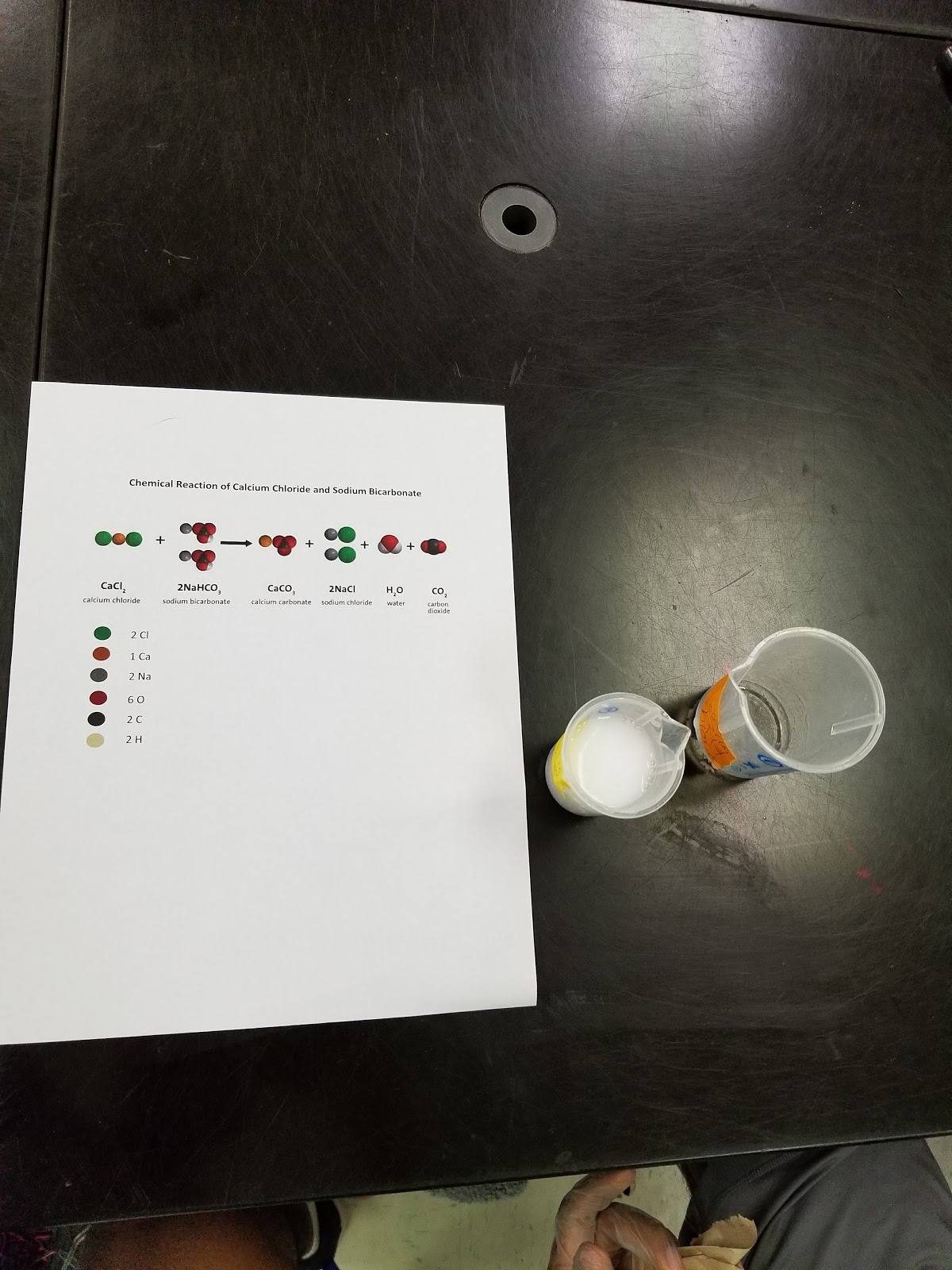
We mixed Calcium Chloride with Baking Soda.  This causes a reaction in which salt, carbon dioxide, and water are formed as well as calcium carbonate.  Calcium carbonate is basically chalk.   So once the mixture was mixed there were bubbles forming which was the carbon dioxide and a lot of white stuff which is the calcium carbonate.


Here is the procedure as well as the reaction.


Thanks Davis Drive for having us!


Monday, July 31, 2017

Our Agricultural Future: Students and Farmers

One aspect of my job I love is that I am always meeting new people.  Bayer is so big and there are new people to meet all the time.  There are also many people that come and visit us which provides another opportunity to network with new people and groups.   This week I met people from two different organisations that are really driving results in area of agriculture.

Agriculture Future of America

The first group I met with this week as they were visiting Bayer were some student leaders for the Agriculture Future of America or AFA.  The Agriculture Future of America was "created by the late R. Crosby Kemper, Jr. and other Kansas City business leaders to provide personal and professional development experiences for college students and young professionals in food and agriculture.  Today AFA focuses on personal assessment, communication, change management and lifelong learning to develop professionalism, entrepreneurial and intellectualism."

I personally was able to sit down with three of these students and two other Bayer colleagues to talk about our careers and potentially instill some insight for these future leaders.   In hindsight I think it may have been been them giving me some perspective and insight.   As I get older it is sometimes easy for me to forget what it was like being a college student and trying to find my way.   "What do I want to be when I grow up" is a heavy burden for many students and one that we all can help them with.   These young students reminded me how important it is for those of us in agriculture to share our experiences and share our love and passion for this career path.  It is easy to forget that that year after year students graduate and have to decide what they are going to do.  Talking to these students I know firsthand that having someone share their experiences goes a long way into helping them make their own choices.    I also realize that by not being proactive there is a lot of talent that may never even know how much they would enjoy a career in agriculture.


If you are like me you probably remember the FFA or Future Farmer's of America.  The AFA is another resource for our youth that should not be overlooked.   The AFA networks with academia and companies to provide scholarships, training, and internships for those that are interested and apply for these opportunities.  A clear message you will hear from those who have taken advantage of the AFA is that the AFA is about "Building Bridges."

Here was one page from an AFA brochure that gives more info:


Go check out the AFA site for more info:  http://www.agfuture.org/s/1342/rd16/start.aspx
Follow them on twitter:  @AgFutureAmerica 


Global Farmer Network

The other organization that visited us was the Global Farmer Network.  I was two for two this week because I had not heard of the Global Farmer Network either.  I had to look up more info on this group.  Here is a quick recap of what I found:

We had 4 farmers from this network come visit for a Q&A with Bayer employees.  They were a joy to talk with and had very diverse backgrounds since they came from New Zealand, India, Argentina, and the US.    It was great to see how much the farmers support agricultural technology including GM options.  Even with all of the anti-GM opposition in India, Farmer Ravichangdran who is from India was advocating for science.  Go follow him on twitter:  @FarmerRaviVKV  He is very active on twitter and can give you a great perspective on agriculture in India.

With so many false claims running rampant on social media, we need farmers like Ravi spreading truth.


He is just one of many farmers in the Global farmers network that are out there raising awareness on multiple agricultural topics.  This is a group I will definitely pay more attention to going forward.  There website is full of lot of great information.

Go check out their website:  http://globalfarmernetwork.org/

Here are other twitter names to follow for the GFN
@World_Farmers 
@GlobalFarmerNet


My eyes are opened everyday to those who are advocating for science and agriculture.   Our youth is our future and it is easy to forget that we really need to take the time to support them.  Just sharing our own experiences and listening to their concerns and challenges goes a long way.  Other times we are in  a constant fight against the myths everywhere.   In a conversation I heard it mentioned that false information is like a virus and it spreads quicker than ever with internet and social media.  Just a few sentences can create fear that is so hard overcome.  Become an advocate and share the science.  These groups represent some great resources to get you started.

Monday, March 27, 2017

Science for kids - The Iodine Clock

Some of the best parts of my day are when I get to go to a school or organization and talk about science with kids.  Just the other week I went to Davis Drive Middle School with a colleague (Thanks Mandy!!) to talk about chemistry.   We visited an after school chemistry club and it was obvious these kids were passionate about science and chemistry.

We talked a lot about pH and how it can affect plants.  We also talked about how certain molecules can interfere with other molecules.  This is important in the plant world because certain nutrients can suppress or even increase uptake of other nutrients.  It is important in human health as well.  Many of us have taken medicine and heard from our doctors certain rules we need to apply while on the medicine.  For instance don't eat grapefruit while on this medicine because it can interfere.

So one experiment we did was to try to show how certain components in a solution can interact with other components in a solution.  It is a very visual experiment and done with household supplies.

The supplies you need are Vitamin C (1000 mg), Iodine (2%), Hydrogen Peroxide (3%), and liquid starch.


You will be making two separate solutions.

Solution 1 is a combination of the vitamin C and Iodine tincture in water.

Solution 1 - Step 1.  Mix 1000 mg of vitamin C in 60 mL of water.  The vitamin C we had is 500 mg tablets.  We crushed 2 tablets pretty easily and mixed the powder in water.  We had colored tablets which will work fine.  If you can find non-colored vitamin C that will work just great as well.


Solution 1 - Step 2:  Next add the Iodine to the Vitamin C and water.   You will add 5 mL of the Iodine to the solution.


At this point solution 1 is done!


Next we will make Solution 2 which is a combination of water, hydrogen peroxide, and liquid starch.  

Solution 2 - Step 1:  Add 15 mL of hydrogen peroxide to 60 mL of water.

Solution 2 - Step 2:  Add 5 mL of liquid starch to the water and hydrogen peroxide mixture.

We are now done with solution 2.


Once you have your two solutions, we can start the reaction.


Grab a new clear container and pour solution 1 and 2 together in the new container.  You can pour the new solution back and forth between empty containers a few times to be sure it is well mixed.


At first it will look like nothing is happening.


Over time (hence the clock), the solution will instantaneously turn dark blue-black!!


So what is going on?  Well when starch and iodine molecules mix you get a dark blue.  However we added some other things that interfere with this reaction.

One reaction that is going on is production of I2 molecules.  The hydrogen peroxide was added to the household iodine and it forms Iodine molecules.  When iodine meets starch it turns blue-black.  

+ 2I – (aq) + H2O2(aq) ->I2(aq) + 2H2O(l)

However we did not get a blue-black color immediately. This is because a second reaction was underway due to the addition of the Vitamin C powder.   The I2 produced from the hydrogen peroxide should react with the starch, but instead it immediately reacts with ascorbic acid (from the vitamin C tablets).  This prevents the I2 from reacting from the starch.  In essence it is shielding the I2 from the starch.

I2(aq) + C6H8O6(aq)-> 2H+ (aq) + 2I – (aq) + C6H6O6(aq)


Eventually the ascorbic acid is used up and there will be enough I2 react with the starch and get a color change.  This is a great example of how certain molecules can hinder other molecules.

It was a fun day at Davis Drive middle.   This reaction can be sped up or slowed down by certain variables as well.  We actually split into two groups.  One group used 60 ml of water for solution 1 and 2.  The other group only used 30 ml of water for each solution and we compared which reaction went the fastest.   What do you think?   If you want to experiment or read more at home here is a great resource:  http://www.greeningschools.org/docs/VitaminCClockReaction.pdf