Monday, March 21, 2016

Astrophotography: Comet Lovejoy C/2014 Q2

There are those vivid memories of childhood that are just as clear as they happened yesterday.    I have one of those memories from growing up that I think it part of the reason I love space.  I was a kid and my dad took me out on a night adventure.  We had a creek that ran through the farm and once a year these large sucker fish would would swim upstream to spawn.  We would put on waders, walk up the creek with our flashlight and go fish gigging.   That was fun, but that one spring as we finished gigging and came out into the open field a large comet was visible in the sky.  I remember it being spectacular.  The tail took up almost half the sky.   Halley's comet had come when I was in second grade and I don't really remember it.   So this was my first experience with seeing a comet.  I don't even remember which comet it was, but it was stunning.   I had never seen something so beautiful in the night sky before.

Years passed and just recently I was so ready to see comet ISON when it got all its hype as the "comet of the century."  Yet that one basically disintegrated as it made it trip around the sun in 2013.  So then out of the blue, I was seeing amateur astronomers taking pictures of Comet Lovejoy C/2014 Q2 last year.  The comet gets is name from Terry Lovejoy who is the guy that found the comet.   By the way, he has discovered five comets so far that are all named after him.

I had to try my luck at getting a picture.  This comet was not going to be like the oneI saw as a kid and take up much of the night sky.  However, with a telescope some very nice pictures were taken.  I never got a spectacular picture, but I was happy I did get something.  It is the first comet I had ever tracked in the night sky with my telescope and so far the only one I have taken a picture of.   Comets are a little tricky since the the they are moving differently than other deep sky objects.  The basic process is still the same.  I take multiple exposures of the comet as I track it and then stack all those pictures together to get one final photo.  I processed the data two ways.  In the first processing the comet itself is the focus and the stars are blurred.  Each frame the comet had moved so much that the stars are in different locations and so while the comet is stacked together the stars are not which is why the stars form streaks in the picture.  .  The second processing took into account the comet location and star location in each frame and stacked them together in the same locations.  The software that does this did a really nice job, but it was still time consuming since i had to manually mark the comet's nucleus in each frame to give the software a frame of reference.


Processing taking into account just the comet location

Processing taking into account comet and star location 


Comet Lovejo C/2014 Q2 ended up giveing a very nice tail.  My pictures only show a hint of what is really there.  Take a look at some of the professionals to really see the beauty of this comet when it was visiting.  It gave off a green/blue light as the sun heated it up.  There were at least 21 organic molecules coming off the comet in gas form including sugar and ethanol!

Hopefully another comet will come visit us in the near future, but this one won't be back for 8000 years!  No one on Earth will see this one again for quite some time.

Monday, March 14, 2016

Making it Personal: Show your support for GMOs


As as I was looking into the petition to take GMO ingredients out of Girl Scout cookies I had a revelation.  Actually it wasn't even a revelation, but more of a confirmation.  A confirmation that GMO supporters are not as strong in the grassroots initiatives like the anti-GMO supporters.  The girl scouts petition was a perfect example.   A girl scout put her voice against GMOs on the site change.org and received over 47,000 signatures to date.  It was enough of a voice to get her an audience with the Girl Scouts.  The Girl Scouts organization still listened to science and kept GMO ingredients in their cookies, but I can guarantee that petition pushed someone that was on the fence to think GMOs are dangerous.  Decisions based on a emotions happen to all of us at some point.  A good story can capture our hearts whether it is based on a true story or not.

The biotech industry pushes out facts and brochures in an attempt to educate the public.  Scientists talk about their research to their friends and neighbors.  The education effort must not stop, but in my opinion this is not enough.  The anti-GMO movement in many cases is using false information, but it doesn't matter if that story grabs someone by the heartstrings.  It is a personal story and people are emotional beings.  A story captivates much more than bars and graphs for many people.  The pro-GMO movement is not making it emotional, at least on the same scale as its opponents.  That emotional grassroots movement is what we need.  

I went to change.org and searched GMO.    Here is a nice excerpt of what is shown:


I know that lots of people already have their mind made up.  There is a group that will not be swayed and many of them will support these types of petitions.  Yet, don't be naive to think these types of tools on the internet don't also persuade people that are on the fence.   These petitions are from people that feel so strongly about there view that they try to persuade other's to share the same viewpoint.   Where are the same stories from a from a pro-GMO view?  They almost non-existent.

I know we have science on our side.  The safety record of GMOs is impeccable and the benefits are well documented, but almost everyone in Europe vehemently opposes GMOs.  Even in the US there is some opposition. We have to make this emotional and take the battle to the front lines on a personal level.  The science by itself is not enough.  Just use Europe as a case study.  People need to connect to the science emotionally.

I made a change.org petition to support GMOs.  Show your support.  Show other's that feeding the world and making better tools for the farmer's is not just a job for us.  It is a personal mission.   We want to make a difference in the world.  I please with you to go to this link, sign you name and show your support for GMOs.  Even write a comment and share your story.  We can change the culture even if it is one person at a time.  We have to try.

Click to sign: Support the science based benefits and proven safety of GMO crops to feed a growing population


Monday, March 7, 2016

Girls Scouts: I love those GMO cookies

I work at Bayer CropScience and as you might expect we talk about GMOs and public acceptance quite a lot.  I get a lot of ideas from interactions I have with the friends, family and even strangers when the topic of GMOs come up, but my colleagues at work feed me a lot of ideas too.  It was just the other day that we were talking about GMOs at work when someone brought up the girl scouts.

I love scouting.  It is a wonderful program designed to teach kids valuable skills and develop them into leaders.  I have two boys that actively participate in cub scouts and I have enjoyed being a den leader as well as going through the ranks of boy scouts when I was a kid.  However I have not had much experience with girl scouts.  I have a daughter, but she is still too little to be involved.  That does not keep me from buying the infamous girl scout cookies when they come knocking on the door.

http://www.abcsmartcookies.com/thin-mints


So what do GMOs and the Girl Scouts have in common?  Well, my respect for the organization grew even more when I started fact checking the connection myself.  The truth is those girl scout cookies that I love so much are made with GMO ingredients and the Girl Scouts have not changed that stance even with pressure to do so.

The cookies use GMO ingredients but there has been plenty of pressure to switch to all non-GMO ingredients.  A petition was started in 2013 by a girl scout to get the Girl Scout organization to stop using GMO ingredients.  The Facebook page is still going strong and the petition has over 47,000 signatures.


I was hunting for the reason why the girl scouts are being petitioned to remove GMO ingredients and found the letter describing the anti-GMO position.


This letter sums up the information war that sadly anti-GMO groups are winning and the misconceptions that the industry is having a hard time changing.  Let's look at this letter in depth.

1.  "If Girl Scouts continues to make cookies with GMO ingredients, our soil will continue to be saturated with pesticides"

GMOs in many cases help decrease the use of pesticides.  Quoted right from the publication Science, "Overall pesticide use on U.S. farms dropped 0.6% a year from 1980 to 2007."   Bt corn is a prime example of a product whereby insect eat the plant and die so less pesticides need to be applied.


http://www.sciencemag.org/site/special/pesticides/infographic.xhtml

2.  "Our Farmer’s will continue to pay higher prices for seeds and purchase larger quantities of pesticides."

It is easy to say farmer's pay a higher cost for GMO seed, becuse at face value that is correct.  However farmers are more than willing to pay a higher cost for GMO seed because the yields and thus the profits are higher.  I really encourage you to read this article:  https://gmoanswers.com/ask/what-difference-cost-production-gmo-vs-non-gmo 

 I can summarize just a small part of this issue from that link.  

A farmer in Maryland has grown GM and Non-GM corn and soy and run the numbers.


GMO seed does indeed cost more.  There are research costs associated with new technology.  A lot of scientists put in hard work and time to bring a better solution to the farmers.   However look at the gains.  Income per acre is much higher because the GM solution provides higher yield.    Delve into the article for even more comparisons and perspective.   Even more important, talk to farmers about GMOs and see what they use and think.  Get their perspective and you may be surprised that most farmers want new biotech solutions if it means higher yields.

3.  "Our bees will continue to die off."

There is no dispute that bees are dying off.  The issue is complicated because there is not just one thing killing the bees.  Instead there are many factors and they are all coming together.  Climate change and the parasitic varroa mite are all part of the issue.   Certain pesticides if not applied properly can kill bees.  And now hot off the press is more research that was just published in Science that shows a virus called the deformed wing virus may be part of the problem too.  We know the varroa mite can pick up viruses from the bees blood and transmit it to other bees.  If the varroa mite and deformed wing virus are in the same hive the results are dead bees and estimates are that the two have joined to kill millions of bees.  Bee death is a challenge we must solve, but no where in this discussion is anything about GMOs killing bees.  In fact GMOs may be a tool to help protect bees from insecticide use.  If less insecticides are used due to GM technology there is less risk that insecticides are used improperly and will kill bees. 

Take a read on the new science:  http://www.ibtimes.co.uk/bee-decline-two-diseases-are-combining-destroy-global-honey-bees-1547415


4.  "In eating the cookies we will continue to gamble with our health."

I have shown and talked about GMO safety in many previous blog entries.  Take a look back at the science.   This info graphic sums up safety quite well.  GM food is safe and we have the science to prove it!


http://www.foodinsight.org/biotechnology-gmo-food-safe-who-infographic


5. "Please research GMOs thoroughly and understand no long-term studies have been done."

Yes, please really research GMOs including the "1783" studies that have looked at safety.  Research the benefits including higher yields and less pesticide use.  Research projects like Golden Rice (GMO rice with increased vitamin A) and the humanitarian efforts that GMO crops can provide the world.   Talk to farmers and get their perspective.  Talk to scientists doing this work over dinner and see that they are trying to make a difference.  There is no corporate conspiracies.  We love science, we love agriculture and we want to provide farmers with a tool to help feed people.

In the end the Girl Scouts did do their research and listened to the science instead of the fear.   Their stance is listed on the Girl Scout website.  So when the Girl Scouts come to my house next time I might just have to buy a few extra boxes.

http://www.girlscouts.org/en/cookies/all-about-cookies/FAQs.html


Monday, February 22, 2016

Say CHEESE: The real GMO picture

I remember in college taking a food microbiology class.  How hard could a class about food be?   Food is not complicated is it?  Then we started learning all kinds of things about pH, fermentation, enzymes, bacteria, etc and how those things interact with food.   I quickly learned that food is complicated especially food that needs to go through a biological process before the final product is available.   A perfect example of a food like this is cheese!  Look at this process in the figure below.  I quickly realized that the science of cheese is not as straightforward as I first thought.


http://wiki.ubc.ca/File:Cheese-production.gif


For an introduction at cheese making, here is a great article:   http://www.cheesescience.net/2007/07/introduction-to-cheese-science_30.html .  The site summarizes very nicely in one sentence a very simple definition of the cheese making process. "Cheese manufacture, which dates from 6000-7000 BC, is essentially a method for preserving the nutritive value of milk through fermentation, removal of moisture and addition of salt."

I wanted to focus on one step of the cheese process:  the coagulation step.   Say what? Remember this nursery ryhyme growing up?

https://en.wikipedia.org/wiki/Little_Miss_Muffet#/media/File:Little_Miss_Muffet_1_-_WW_Denslow_-_Project_Gutenberg_etext_18546.jpg


Miss Muffet likes the results of coagulation.  The coagulation step is when the milk "clots."  You may have heard the same term referenced with blood.  When our blood clots it is coagulating.  Milk coagulation is when the the casein protein in milk is broken down so that the milk curdles.  The milk separates into solid curds and liquid whey just like like Miss Muffet likes.   Milk does not just spontaneously separate into curds and whey.  There are so many types of cheeses and thus there are multiple ways of making milk coagulate.  In many of the popular cheeses, including swiss, cheddar, and mozzarella an enzyme is added to the milk to start the breakdown of the casein protein, This special enzyme is called rennet.

http://slowfoodwellesleysnail.blogspot.com/2014/01/wasiks-cheese-lecture.html


Rennet is an important enzyme in the business of making cheese so where does it come from?   Nature first provided the answer.   Calves that drinks their mother's milk need to be able to break it down sand so baby calves produce the enzymes, ie rennet to break down the milk.  The enzyme occurs naturally in calves stomachs and cheese makers took advantage.   Rennet is harvested from a calf's fourth stomach, a process that involves killing the animal.  Harvesting the stomach is a by-product of the veil industry.  The rennet that is harvested from a calf's stomach is a mixture of chymosin, pepsin and other proteins.  Chymosin is the most important part of the rennet to coagulate milk.

The animal rights movement started to take off in the 1960s.  Due to that movement the rennet price became very unstable as there was a resistance to killing calves to harvest stomachs.  Whether you have a problem with the animal slaughter or not, the fact remains that getting the rennet from calf's was a laborious process and costly endeavor.  With pressure of animal right groups, cheese producers tried to find alternative way to obtain rennet.

Welcome to the world of GMO microbes.   Scientists discovered in the 1980s a way to genetically modify bacteria with one gene from the bovine genome to produce chymosin , the main milk caogulation factor found in rennet.    TheGMO microbes are grown in liquid culture and as they grow and express the bovine gene they release chymosin into the liquid culture.  The liquid is gathered and the chymosin is purified and then used to make cheese.   The purified chymosin is called FPC (Fermentation-produced chymosin)  and was approved by the FDA in 1990.

http://www.nytimes.com/1990/03/25/us/gene-altered-item-approved-by-fda.html

Today, 90% of the cheese made in US use FPC.  Scientists now synthesize (or artificially make) the gene needed to make FPC without actually using DNA derived directly from the animal.   The use of GMOs to produce FPC is an important use of biotechnolgy in that it was used to solve a problem no matter where you stand on animal rights.   It is a cheaper solution that produces an even purer form of the enzyme needed to make cheese.

The GMO bacteria are releasing the enzyme and it is purified.  No actual GMO bacteria are put into the cheese and thus even if GMO labeling comes along cheese may not be on that list.   The cheese itself does not contain any genetically modified organisms, just the purified enzyme from a GMO.   In Vermont, a law is set to go active in July 2016 requiring GMO labeling of food in that state.  Guess what will not have a GMO label?  You guessed it.  Cheese will be exempt from that law.  Yet make no mistake GMOs are being used to help make certain types cheeses and it is a safe and cost effective solution.

So next time you eat cheese, think about the beneficial effects of GMOs.  The next time someonce says, "Say Cheese!" then share with them the real picture.   GMOs have been a part of cheese making since the 90s with nothing but positive results.   Eat some cheese and advocate for GMOs.  


Monday, February 15, 2016

Astrophotography: Iris Nebula

We just had Valentine's day and so I thought a fitting post would involve flowers.   There is a beautiful "flower" in space called the Iris nebula.   There are a different types of nebula with the most common being an emission nebula or a reflection nebula.   Both types of nebula involve dust and gas in space. An emission nebula is when energy from a nearby star ionize the gas usually resulting in a red color.   The Iris Nebula is a reflection nebula.  A reflection nebula is when there is not enough energy from a nearby star to ionize the gas, but the energy is scattered through the dust.   When the energy is scattered it reflects off the dust and commonly causes a blue color.

A beautiful reflection nebula is the Iris nebula which reflects a beautiful blue color.  It is 1300 light years away and six light years across.

I took this photo with a Celetron Edge 8 HD and comprises about 1 hour of exposure. 


Monday, February 8, 2016

Zika Virus and Genetically Engineered Mosquitoes

The Zika virus has been dominating the news lately and I am sure you may have already heard enough.  However there were a couple of topics I wanted to blog on this week.

1.  Some rumors are spreading on the internet (image that!) which actually say Genetically Modified (GM) mosquitoes caused the Zika Outbreak

2.  Secondly, should we be genetically modifying mosquitoes?  I have my own thoughts on this and wanted to pose a couple of questions before you answer that question for yourself. 


https://en.wikipedia.org/wiki/Mosquito#/media/File:Aedes_aegypti.jpg


Genetically modified mosquitoes did not cause the outbreak!

We can start the story with a quick recap.  Zika is a virus spread by mosquito, specifically the Aedes aegypti mosquito.  The symptoms of the disease are quite mild.   You can develop a fever, rash, joint pain and conjunctivitis that may last for 2-7 days.   In some cases someone with Zika virus may not even know they have it due to the mild symptoms. The virus was first identified in 1947, but it is now making headlines because of a very large outbreak in Brazil that started in 2015.  Since that outbreak, a large number of babies born with microcephaly has been on the rise.  Microcephaly is when the baby has a smaller than normal head due to incomplete brain development.  While an adult suffering from Zika is a non-issue, babies born with micorcephaly is a very large problemfor obvious reasons.  There is still no definitive science that has shown Zika is the cause of microcephaly, but the correlation is strong and the main assumption at this point.  Lots of research is going into this area and if you want more info on the ongoing science take a look at this scientific paper:  http://www.cdc.gov/mmwr/volumes/65/wr/mm6503e2.htm

The second part of the story is that there is a company called Oxitec that has genetically modified mosquitoes that they hope will help reduce dengue disease.  The mosquitoes being targeted are Aedes aegypti since they are the specis that carry dengue, but also happen to the the same species of mosquito that carry the Zika virus.  That is good news because the Oxitec technology could help with Zika.   Oxitec conducted a trial with these mosquitoes in 2011 in one Brazilian city and the trail was an overwhelming success.   The local population of Aedes aegypti mosquitoes were reduced 90%.  

The technology behind Oxitec's GM mosquitoes is very exciting.  I encourage you to go to their site and read about it.  Here is an excerpt from the site http://www.oxitec.com/ that really goes into detail on how the mosquito are made:  Keep in mind only the non-biting males are engineered.


Finally the two stories come together when social media decided to spread a rumor just likes its own virus.  Headlines, Facebook posts, and Twitter posts were ablaze with false information that the reason we have the Zika outbreak in Brazil is because of these GM mosquitoes.  


The claims are a complete joke, but you probably saw the headlines somewhere and our brains are quick to say "Hey that might make sense."  We really need to look at where the claims are coming from and the science to debunk it, something that requires extra work.  The rumor started because a Reddit post showed the outbreak location in Brazil was close to the Oxitec GM trials.  That post ballooned into GM mosquitoes caused the outbreak.  When we look at the facts the locations pinpointed are actually far away from the outbreak.  The other big debunking fact is that the Brazilian Zika outbreak occurred in 2015 and can be traced to other outbreaks, while the Oxitec trials were four years earlier.   For the detailed facts check out this article:  http://www.theguardian.com/world/2016/feb/04/alert-theres-a-dangerous-new-viral-outbreak-zika-conspiracy-theories

Even Snopes, a site that facts checks rumors commented on this one:  http://www.snopes.com/zika-virus-gmo-mosquitoes/

http://www.snopes.com/zika-virus-gmo-mosquitoes/


The rumors once again make GM technology seem like an evil thing.  In this case the critics are spreading fear and that fear can spook regulators.  Regulation is supposed be science based, but that is not always the case.  Every delay is causing more Zika virus to spread and if it is truly causing microcephaly, then every delay is also causing human hardship even though we have the tools to fight. 


Should we even genetically modify mosquitoes?

Let's start with  the fact that  manipulating insects is not a new thought.  There is another insect called the screwworm (don't eat before Googling that one).  The screwworm fly lays eggs in a wound and the screwworm larvae hatch and "drill" down in the wound and eat the flesh.  Cattle are affected the most, but they can affect other animals.   The screwworm can of course cause death and was major problem in the Americas.   To gross you out more, the worms can affect humans as well.  The economic impact from cattle losses was so large that a facility in Panama was built to constantly rear screwworms flys, irradiate them to sterility and release them by airplane.  There are so many sterile flies that any normal female only meets a non-sterile fly and the population stays low.  This operation never stops and employs about 400 people with a budget of 14 million per year (2014 data).  That is very little money and resources compared to the billions of dollars in losses to farmers if the fly was still around.   So manipulating an insect is not a brand new though or technology.  We have been doing it since the 50s when the screwworm fly program was first started.

I know this can be an ethical question for some.  How could we eradicate a bug even if it is a mosquito.  What are the environmental impacts?  Don't worry about eradicating all mosquitoes with this technology.    There are 3500 species of mosquitoes and only a very small number of that transit disease to humans.   Any technology is going to be very targeted and only used to help people. 

The fact remains that we have a tool to save lives and reduce disease.  Before you make your final judgement run these scenarios in your head.

1.   There are no Zika carying mosquitoes around me.  Should we release genetically modified mosquitoes?

Now ask this one:

2.  My daughter is pregnant and my neighbor was just diagnosed with Zika virus.   Should we release genetically modified mosquitoes?

For me the answer is pretty straight forward.  I value human life and the science has shown that the technology is safe.  I am heartbroken from the images of crying moms in Brazil and ready to put science to work to solve some of our world problems.  Don't let good science and the potential to save lives be delayed because of something you have not verified on social media or word of mouth from a friend.


Monday, January 25, 2016

GMOs cause allergies: More false propaganda

I hear one concern about GMOs more than most and it is a concern that also comes up on surveys about why people are scared of GMOs.   People are fearful that they will be allergic to GMOs.   This Frankenfood has foreign DNA that is going to be harmful if you eat it.   I don't want to get off topic, but I want to clarify one thing. When two cultivars of the same crop species are crossed there is foreign DNA being introduced as two different plants combine DNA to make a new plant that is genetically different from its parents.   I know the argument then shifts to "well there is DNA from another species in my food with many GMOs."  I have a couple blog posts already showing that in nature foreign DNA from other species is being incorporated in plants,w including in foods we eat now like sweet potatoes.

But lets get back to allergies.   The GM plant is now making a new protein and so I might be allergic to GMOs.   It is true that food allergies come from proteins and biotech companies are well aware of allergen risks.  However if you read any anti-GMO propaganda you will quickly believe that allergens in GMOs are all over the place.  Again the fear mongering without the facts is rampant on the internet. Just one quick Google search and this was the first thing that pops up for me.

https://www.organicconsumers.org/old_articles/ge/allergies111603.php

Read this and you would think biotech companies are just carelessly putting products on the market.   Most of the proteins "have never been ......tested for their safety"   Really!!  Wow.  These lies are why the public has such a misconception of GMOs.  The FIRST thing a a company does in the early research is run any new protein against a database of known allergens.  If it is even remotely a hit the protein is dropped.  Secondly a new product takes 10-15 years to reach the market.  Agronomic testing and breeding multiple generations to get the final seed is part of that long timeline, but regulatory and safety testing is the other reason.  Any new product goes through a lot of testing to ensure the new protein is safe.

Go to http://www.allergenonline.com/ and dig around there for a bit.   This is a database maintained by the University of Lincoln-Nebraska and contains peer reviewed sequences of allergens.   There is so much science to make sure allergens are a non-issue in any GMO product.   This is a great database and not even the only one that will be used in an allergen cross-reference.

Here is an excerpt from an article on the same topic. When you get a chance check the entire article out at https://www.geneticliteracyproject.org/2014/04/16/are-gmos-causing-an-increase-in-allergies/


I have heard of people saying they cut out GMOs and all of a sudden there allergies were cured.   In the US, 90% of allergies come from peanuts, tree nuts, milk, eggs, wheat, soy, shellfish, and fish.   If you want to see what GM crops are approved then check out this nice resource:  http://www.isaaa.org/gmapprovaldatabase/.  The only GMO crop widely available in the US consumer market that is a known source for food allergies is soybean.   Monsanto is working on a wheat variety that will be resistance to Round-Up but it is limited in availability at this time.  So most of the allergy inducing foods out there aren't even GMO to begin with.

The GM varieties that are on the market are scrupulously tested for allergen hits before release.    In fact some I would wager that GM crops are tested more for allergens than many "non-GM" foods that have been introduced in the US.  Now I love Kiwi's, but they were not tested for allergens when introduced in the US in 1962.  However, Kiwis can cause serious allergies in some.  For more info on Kiwi allergies take a look at http://allergicliving.com/2010/09/01/serious-fruit-allergy-kiwi/    The fact remains that Kiwi's are not in the headlines as some evil food because it causes allergies.   If you are allergic to a protein in soybean, then you are going to be allergic to it no matter if it is GMO or non-GMO.  And when there is a GMO variety, there are a minor number of protein additions which again have been robustly tested for allergies. Everything else about the plant is the same as any other soybean plant.

The bottom line is I cannot say that no one out there will NEVER be allergic to a new protein from a GMO crop.  However you are more likely to be allergic to something that is already a known allergen than any protein that a biotech company discovers.  If a new protein shares an amino acid sequence (the building blocks of proteins that ultimately comes for a DNA sequence) with an allergen it is not going to be released.  Because of the strict science and knowledge of what causes food allergies in humans, no new protein from a GMO to date has been shown to cause an allergy no matter what the anti-GMO propaganda may say.

http://www.foodallergens.info/Facts/GMO.html


Monday, January 18, 2016

Astrophototography: Bubble Nebula


I think the bubble nebula may be my one of favorite targets to date.  There is just something captivating about a bubble of gas sitting in space. When you throw a rock into a pond you see a ripple travel through the water.  That ripple might even even travel the entire width of the pond.  It boggles my mind to think "ripples" of gas are traveling through the universe, but instead of pond size the ripples are light years in size.    In the case of the bubble nebula a very big star that is 45 times the size of our sun and hundreds of thousands of time brighter, has sent out its own ripple of stellar wind   The star's stellar wind has blown gas from around it, and the gas is contained in a tight bubble by a molecular cloud that happens to be in the same area.  The bubble we see in the picture is actually 10 light years across.

In astrophotography half the battle is taking the photos through the night.   However the other half of the battle is putting all of that data together to get your final picture.  I have tried several programs to get those final images and tend to use Pixinsight and StarTools the most.   The first picture is the final picture using Pixinsight.  It is probably the best representation of the nebula in terms of color, but the StarTools picture turned out decent as well.   These pictures just show that there is a lot of complex interactions going on when you combine 70 two minute exposures.  Every time you combine the data the final result is going to be a little different.


Monday, January 11, 2016

Is antibiotic resistance predictive of stagnic farm production?

So I know the title seems like a stretch.  How are antibiotics and farming even remotely connected and in reality they are not.  However there are correlations I see among both topics that I wanted to explore.

It all started when I was listening to a podcast (Raiolab) and  they were talking about the history of antibiotic resistance. It is a very interesting episode so take a listen:   RadioLab: Staph Retreat  We hear about antibiotic resistance all the time in the news.    MRSA (Methicillin-resistant Staphylococcus aureus) comes to minds as a particular nasty antibiotic resistance bacteria in our hospitals.   Lots of times the term "superbug" is is given to these emerging antibiotic resistant strains.  It is a real problem and so the first question to ask is why are there no more antibiotics coming on the market?

The first antibiotic was discovered in 1928 by Alexander Fleming and was a drug we have all probably taken at one point or another.  I still remember the pink bubble gum flavored penicillin I took as a kid.  With Penicillin the antibiotic revolution was kick started and the media was eating it up.

http://www.nww2m.com/tag/penicillin/

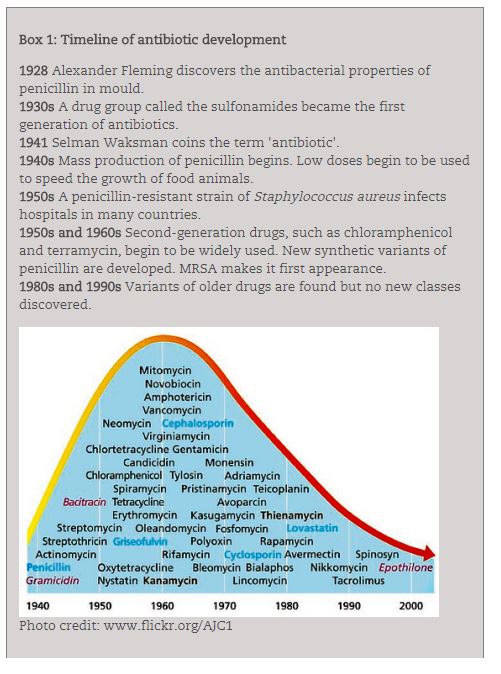
Penicillin was just the first of many antibiotics that  really got going in the 50s and 60s.  At that point there were so many antibiotics coming out that it looked liked we might have an answer for any bacterial infection. The figure below shows the peak of development before development declines.


http://www.scidev.net/global/health/feature/antibiotic-resistance-frequently-asked-questions.html


The other part of the antibiotics story is resistance.  Lots of drugs were coming out, but resistance was developing FAST!  Take a look this figure.


https://agreatcomplexity.wordpress.com/2012/05/05/the-cost-of-resistance-our-current-models-of-antibiotic-research-and-development-are-unsustainable/

Penicillin is introduced in 1941 with some resistance in the 40s.  Streptomycin is introduced in 1944 and resistance comes within a couple years.  Methicillin was introduced in 1952 and resistance was seen in 1960.   This list goes on with the same general trend.  When an antibiotic is developed the bacteria are very good at developing resistance and many times that resistance came 1-3 years after release.    Since the onslaught of new antibiotics in the 50s and 60s, the number of antibiotics have dramatically declined.   There are numerous reasons for this, but as the figure above mentions one of the biggest is that it is not appealing for pharma companies to spend millions on a drug that once released will only be used for a couple years before resistance pops up.    From a business perspective you can't blame them because if they can spend money on a drug that stays on the market for 10-20 years then they can recoup their R&D costs and turn a profit.   However as humankind we all are now suffering from those decisions.  There are very few antibiotics in the R&D pipeline compared to the peak of the 50s and 60s.  We now are live in a world where less new antibiotics are being released and bacteria are continuing to find resistance to what we do have.   As more resistance pops up and antibiotic choices dwindle, I think pharma companies will have to jump back into more R&D. I would predict this move purely on the the model of supply and demand;  especially if these superbugs start causing more and more deaths.  

Now let's jump to agriculture.   I was reading an opinion piece in the New York Times and realized that just like pharma companies not putting money into antibiotic development, the government is not putting money into agricultural development.

http://www.nytimes.com/2016/01/04/opinion/we-need-a-new-green-revolution.html?ref=opinion&_r=2

So we went from 40% of American research towards agriculture in the 1940s to only 2% today.   Many other countries are also not contributing the needed R&D to keep yields going up.   If you go searching for yield gains for crops you will see increases.  However in many cases these increases are coming from private biotech or the fact we are just planting on more land!.

Examples of the impact of a private biotech trait on yield are seen in Bt and herbicides.


http://grist.org/food/why-gmos-do-matter-and-even-more-to-the-developing-world/
So while conventional breeding has shown a mostly linear progression of yield increase, there are points in history for several crops where we see what a GMO trait can do.  Of course we also have increases in yield because land use keeps going up as well.


http://www.nature.com/ncomms/2013/131217/ncomms3918/full/ncomms3918.html


Look at how much land use has gone up in the last 10 years.  By using more land it is easy to mask the true issues we face.   Eventually the land will run out, but the population continues to grow exponentially.  The atricle for Nature sums up this point:

http://www.nature.com/ncomms/2013/131217/ncomms3918/full/ncomms3918.html


Our yields are plateauing and there are many reasons for this including "poor investment in agricultural research and development."


This brings us full circle  back to antibiotics.  I think the antibiotic shortage is predictive of the food shortage problem.  We should use the lessons from antibiotics as a warning.  If we are not going to spend the money and resources towards agriculture then instead of "superbugs we will may have a "super shortage."  GMOs are part of the answer, but we have to remember that the private industry is a compliment to academia and government research.    They are spokes on a wheel and without all three working together progress is much slower.   Academia is at a low for grant money received for agricultural research.  .Hopefully the trends will change.  The major symptoms are hidden in both cases.  There are still just enough antibiotics out there to make things seem alright even with the emergence of superbugs here and there.  There is still land to use that makes overalls yields go up each and every year.   If everything is working then why spend money.  Remember that the pipelines for both antibiotics and new crops can take as long as 10-15 years to get a product on the market.   So just throwing money at a problem may have positive effects, but not immediately.

Keep the pressure on the increase research in our universities.  And keep supporting the biotech industries.  They are all part of the effort to help keep everyone fed.  Here is one of many graphics that show the demand for food production is inevitably going to go up.  The question is whether we can keep the yields on pace.

Twitter @Bayer4Crops


Monday, January 4, 2016

What is on your organics? ...Bt for one

The term "GMO" has become tough to define.  For many it is an evil word, while "organics" are what is going to save the day.   I have nothing against organics, but while GMOs have a mixed reactions organics are the golden child that can do no wrong.  Organics have there niche and I am certainly not above buying them.   My biggest problem with organics is that they are very labor intensive and I do not see them as a sustainable option in the long term future as our population continues to expand drastically.   An even more common problem is the lack of information.    I do not think the general population fully understands that organics still receive some chemical treatment.  Just because something is organic does not mean it it was just grown in a field and nothing but pure water and sun ever touched the plants.

Let's take a look at one of the most common GMO products for insect control.   "Bt" corn and soy are widely adopted by farmers and do a great job controlling certain insects.  "Bt" stands for Bacillus thuringiensis.  Yhese bacteria make a natural protein that kills insects.  This is a similar concept to antibiotics.  Bacteria are always competing against each other and nature and thankfully make these compounds to keep them competitive against other organisms  competing in the same spaces.   The gene that produces this protein has been inserted into plants and when insects digest the protein they die.  But guess what?  Bt has been sprayed on plants for years and is allowed on organics because it is a natural protein found in nature.   In fact it accounts for up to 90% or of the organic pest control market (http://www.bt.ucsd.edu/organic_farming.html).   So GMOs are terrible because they have Bt, but Bt spray is fine.  Say what!!??

Here is my augment summed up nicely from http://grist.org/food/slate-anti-gmo-activists-say-the-darnedest-things/


There are also many other things that may be used on organics that you may not be aware of.   Here is the list of things that are allowed by federal regulations in the US:

http://www.ecfr.gov/cgi-bin/text-idx?c=ecfr&SID=9874504b6f1025eb0e6b67cadf9d3b40&rgn=div6&view=text&node=7:3.1.1.9.32.7&idno=7


Check out this article on the same subject.  It is very informative.

https://www.geneticliteracyproject.org/2015/12/07/myth-busting-on-pesticides-despite-demonization-organic-farmers-widely-use-them/


The point here is that insects are a problem and in order for you to have food to eat insects have to be controlled whether you are eating GMOs or organics.  I feel that organics have this reputation that they have absolutely nothing on them.  I understand the appeal of organics and there is some great tasting and quality food coming from organic farms. However, they still still use options to control insects. including Bt that has been an argument for anti-GMO activists for years.  The good news is Bt is safe whether in your GMO or organic food.