Monday, May 2, 2016

Kid Science: Extracting DNA from Plants

Oklahoma State conducted a survey a couple of years ago that for me really hits home the need for exposing people to science as much as we can.  The survey asked "Do you support mandatory labels on food produced with genetic engineering?"  As expected 82% of people polled agree with that statement.  However another very important question was on the survey that asked  "Do you support mandatory labels on food containing DNA?"   For that that question 80% of participants supported this idea..

Let's think about this one for a minute.  DNA is the building block of life.  Everything living contains DNA including our food which means every food product we eat contains DNA.  The worrisome part is if our society has this misconception on DNA, then of course they are going to have misconceptions on GMOs.  People might support labeling GMOs but it is hard to know if they really understand why they are asking for labels if labeling all food with DNA get the same response.

Well there is a a quick and fun way to show that even our food contains DNA.  We just had National Bring your Kids to Work Day.  A shout out goes to all the awesome people I work with at Bayer CropScience for organizing a great day that not only let us take our kids to work, but introduced them to the fun side of science.   My two boys Landon and Carter got spend a day learning and doing science.  Landon wanted to do one of the experiments we learned again   So we both are on a mission to prove that even plants have DNA.  In this experiment we are going to actually extract the DNA and there will be so much of it we will actually see it .

The items we need are:

Fruit:  Strawberries or Bananas work best
Detergent (Dish Soap)
Salt
Zip-lock bag
Coffee Filter (an funnel if you have one)
Toothpick, paperclip, or wooden stick
COLD Alcohol:  95% ethanol works best   but 70% rubbing alcohol will work too.

The first step is to make sure your alcohol is cold.  This is important to protect the DNA.  Go ahead and put your alcohol in the freezer and get it very cold (it will not freeze).

The experiment:

1.  Put piece of banana or strawberry in a Ziploc bag
2.  Push air out, close bag and and mash for 2 minutes
3.  Add 10 mLs of salty water (just add 3-4 good pinches) + 2-3 drops of dish soap in the bag.  Mash for 2 more minutes
4. Take a coffee filter, place in funnel on top of a tube or container.  Pour fruit paste in filter and let the liquid pass through.  You may have to squeeze the filter.  Bananas are a little pasty and need more help getting the liquid through than strawberries.
5.  Pour 2 ml of the filtered contents into a clean tube.
6.  Add 5 mL of COLD ethanol by running it gently down the side of the tube (2.5 volume ethanol to 1 volume fruit juice).  Do no stir or shake..
7.  Wind the DNA with a stick.  Even before you wind it you will see the DNA suspended in your fruit juice.

Here are the supplies you need:


Put the banana in the bag


Mash the fruit:

Add Salty water and dish soap and mix again.  The soap breaks the cells apart so the DNA will be released out of the cells.  The salt keeps the other stuff in the cells from separating with the DNA.


Pour the fruit paste into a coffee filter and filter the juice into a tube:


Squeeze the paste to get the pure fruit juice:


Get 2 mL of the juice in a new tube.:


Add 5 mL of ethanol down the side.  Do not shake or stir.  DNA is not soluble in alcohol.  So once you add it the DNA is not in a dissolved state like it was was in the fruit juice.  Once it becomes insoluble you can see it with the naked eye.


The DNA is already precipitated out:


Place a wooden stick in the tube and twirl.  The DNA will stick right to stick.  Bananas work so good!!


Yep... It looks like a big snot ball.


Strawberry works too and you get the added benefit of the red color.


Even the baby wanted to do some science. While we were doing this experiment I turned around to find her like this:


Science is fun!  And what an easy and great learning tool.


Monday, April 25, 2016

Astrophotography: Jupiter

Most of the pictures I have taken of space objects are considered deep sky objects.  Deep sky objects are mostly galaxies and nebula.   I know when I think about space I usually think about the planets before I think about another galaxy.  Yet, planets are one of the targets I have probably spent the least amount of time trying to capture.  The main reason is that planetary imaging is much different and in some ways more difficult at least in my opinion.

For deep sky objects the very basic plan is

1.  Take a bunch of images of the object with long exposure times or at least as long as possible for your equipment and location.

2.  Stack your images into one image.

3.  Process that image to "stretch" the date.  In other words pull out as much detail as possible while also adjusting for light pollution and other noise that is introduced

Again this is very general an I will eventually have some posts explaining each step in detail.  However planetary imaging is much different.  Planets like Jupiter, Saturn or Mars require very high magnification.  Besides having a scope that can go to high magnifications, you may also need something called a Barlow or Powermate to further push the magnification of your scope.  Take right off Wikipedia:

"In its astronomical use, a Barlow lens may be placed immediately before an eyepiece to effectively decrease the eyepiece's focal length by the amount of the Barlow's divergence.[1] Since the magnification provided by a telescope and eyepiece is equal to the telescope's focal length divided by the eyepiece's focal length, this has the effect of increasing the magnification of the image.
Astronomical Barlow lenses are rated for the amount of magnification they induce. Most commonly, Barlow lenses are 2x or 3x, but adjustable Barlows are also available. The power of an adjustable Barlow lens is changed by adding an extension tube between the Barlow and the eyepiece to increase the magnification."

The Barlow just helps get your magnification up.  They are very small targets and you need these high magnifications, but the higher the magnification the more you are subject to turbulence from Earth's atmosphere.   That turbulence causes the planet to become blurred.

Our objective is still to get many images and stack them together;  With planets we will be dealing with the turbulence from the atmsophere and so we use a different approach to get our pictures.  Instead of taking a lot of still photos we get our frames by taking a video.  We can then separate each frame from the video and only stack the good ones. The best way to take that video is hook up a USB camera to your telescope


I use a a camera made by ASI called the ASI120MM.   Instead of a DSLR camera attached to my scope I just slide this USB camera in.  So for planets you will usually have USB video camera > barlow > scope.


Then we focus on the planet and record a video.  Watching the video points out how blurry things get.


Some software is then used to break the frams out, find the good ones and stack them.  My first attempt at planetary imaging is honestly not very good at all.  But hopefully I will have some better ones in the future.


Monday, April 18, 2016

9.7 billion by 2050 - Are GMOs the answer?

The world population is growing.  We all know this and hear about it all the time, but how are we going to feed all these people?   Are GMOs the answer?  Can conventional breeding keep up with the rise in population?    Some may argue that we don't need to worry at all.  They would say why worry when already have enough food for today's population, but we just re not distributing it around the world efficiently.   If we do a better job with food distribution then we can already feed more people.

  As a society we do waste more food than we should, but the reality is we are not feeding everyone in the world with our current system.  Sure we could make logistical improvements and feed more people.   However think about the situation we will be in when the population does indeed go up.  If we can't feed the world now, how are we going to feed the world with a population that continues to increase.

When we talk about the world's population increasing we are talking about a huge number of people.  Right now the Earth is home for 7.4 billion people as of 2016.  Estimates vary some about the actual population numbers in the future, but most models are pretty consistent.  Most estimates show that by 2050 our population will increase to approximately 9.7 billion in 2015.

http://www.un.org/en/development/desa/news/population/2015-report.html

There is one fact that cannot be argued.   As we have more people live on Earth we will need more food.  Even if we get better at food distribution and waste less, more people will eat more food.   So what is the solution?  I stumbled on a paper that I wanted to delve into.

The paper is about One crop breeding cycle from starvation? How engineering crop photosynthesis for rising CO2 and temperature could be one important route to alleviation

The paper has a lot of information that I will not get into, but there are a couple of take-aways from this paper that are thought provoking.

1.  We don't have infinite land to just grow more crops

Quoting from the paper:  'Human population growth is putting severe pressure on food production to keep up with increasing demand. Two-thirds of calories are derived indirectly or directly from just four crops: rice, wheat, maize and soya bean. In terms of global production of primary foodstuffs, these are the world's top four crops with 741, 716, 1018 and 276 million metric tons, respectively, produced in 2013 [1]. With rising population and changing diet, it is estimated that the world will require 87% more of these primary foodstuffs by 2050.'


The article points out that we needs to increase our staple crops by 87%.   From a study in 2005, we know that we use 40% of the Earth's land in food production.

http://news.nationalgeographic.com/news/2005/12/1209_051209_crops_map.html


Just take a look at this map from National Geographic.  It is pretty clear that land is a finite resource.
http://www.nationalgeographic.com/foodfeatures/feeding-9-billion/


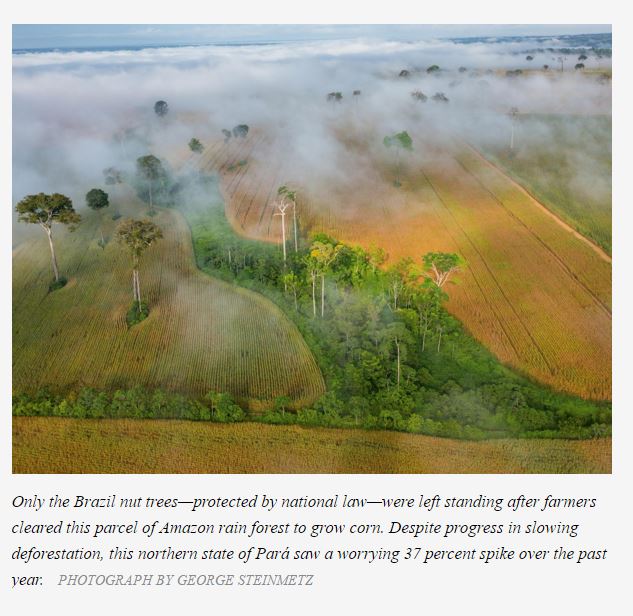
If we already use 40% and we need to increase by 87%, which is no small feat.  I would even say it is an impossibility.  We still need land to live and we still need to take care of environment.   Gaining access to more land means deforestation mostly of rain forests and this is just not a solution   I am sure humankind will use resort to more deforestation in the future but we also need to make more with less.  The is not what we want to continue:

http://www.nationalgeographic.com/foodfeatures/feeding-9-billion/


2.  Conventional breeding is not the only answer

Every culture has a staple crop and world has the big 4 consisting of rice, wheat, maize, and soybean.  When thinking about increasing food we have to focus on these.  These crops are what is going to feed the world which means these operations have to be high yielding and efficient.   The problem is that we have already spent years improving these four crops for yield through breeding.  We are seeing that conventional breeding just cannot keep up with the dramatic increase in food production we need.  Yield increases are are plateauing. Conventional breeding is still needed and I have no doubt it will continue to increase yields on its own merits.  However even conventional breeding is not a quick fix.   It takes 7-17 years to release a new cultivar.   If you are interested in conventional breeding development here is a great read:

http://www.cropj.com/shimelis_6_11_2012_1542_1549.pdf


So development of a new conventional breeding cultivar being developed today, which will only have small increases in yield at best, wont come due until possible 2033.  I feel there is the misconception that conventional breeding will fix all our problems just like it always has.  All of this technology whether conventional breeding or GMOs take time and resources.  More importantly they need support.

Quoting for our paper:  'Additionally, the time required by crop breeding and bioengineering to release improved varieties to farmers is substantial, meaning that any crop improvements needed to mitigate food shortages in the 2040s would need to start now.'


3. We need to use all the tools available

So what are the solutions?   There are many possibilities.  Conventional breeding is one.  Breeding will continue to make some gains.  There is also the possibility of insect farming.   Maybe your next loaf of bread will be made with cricket flour.   There is also the fact we spend a lot of our cropland providing food to feed animals.  I love meat in my diet, but the fact is we may need to improve our efficiency of raising animals too.  Lab grown meat is a possibility; we have already seen farm raised GM salmon that grow faster.  We can still become more efficient in how we farm.  Digital farming is becoming better and better to be able micromanage each area of a farm.  Yield maps can be made that correlate to soil parameters so that each part of field can be treated differently to maximize yields.     Of course we cannot rule out GMOs either.   As the technology improves I really believe it will be one answer to increase our yields.  The authors of the paper we have been discussing have talked about increasing a plant's ability to use carbon dioxide more efficiently to increase yields.  There are even more approaches from a biotech side that in combination with all these other tools can help make sure we feed everyone.

The take home is that we can't just wait until 2040 or 2050 to worry about this problem.  All the potential solutions on the table take time to research and develop.  It does not help when many are adverse to biotech solutions.   Even some governments are not asking science based questions when it comes to approving GMO crops.   We need to open our minds to all the tools, answer our questions with science and fact, and educate on this topic.  Just because we have food on our tables does not mean we are less responsible to make sure future generations have food as well .  We don't want to be "One crop Breeding cycle from starvation."


If you want to take a deeper dive into other solutions for feeding the growing population, the national geographic article is very good:

http://www.nationalgeographic.com/foodfeatures/feeding-9-billion/

The paper discussed in this article also has another blog post that covers some of the same opinions, but is also worth reading.  I did not get into organic farming and the increasing population which this blog does touch on.

http://theness.com/neurologicablog/index.php/the-need-for-improved-food-production/


.

Monday, April 11, 2016

Science for Kids: Make a comet

I shared a post a couple weeks ago about taking my first photo of a comet.  Comets are amazing when you think about them as a big ball of ice and gas travels through space.  As it gets closer to the sun it begins to heat up and that gas and ice leaves a big tail that we associate with comets.

To understand exactly what a comet is, you can make a small scale version.  This was a project I had done last year at my son's school when they were learning about space.  The best part is you get to play with dry ice, which you can buy at certain stores.

There are a couple safety concern with this project.  Dry ice is is very cold so you should have the appropriate gloves to handle it.  It can cause burns very easily if it stays on exposed skin.  When dry ice sublimates it makes carbon dioxide which can displace oxygen in an enclosed space.  Make sure you are working in a large room.  As long as you are careful it is safe to work with.

The supplies you need are:

2-3 cups of dry ice
2 cups of water
Small handfull of dirt or sand
Garbage bags
Mixing bowl
Wooden mixing spoon
Hammer
Safety glasses and gloves

To make your comet you just need to follow these steps:

1.  Crush you dry ice.  Most dry ice comes in a block or in pellets.  Place the dry ice in a garbage bag.  Double bagging works best in case you have a hole.  Take a hammer and gently hit the ice in the bag.  This is easy done with the bag on a garage floor or a sidewalk.  It will crush easily.

2.  Place the ice in a mixing bowl that is lined with a garbage bag.   If the garbage you just used to crush the ice is still in good shape then just place it in the the bowl.  Open the bag so the ice is exposed.  Or you can pour the crushed dry ice in a new garbage bag that is lining a bowl.

3.  Add the sand or dirt and mix it into the ice.  The dirt is another component of the comet and will give it that dirty look.

4.  Pour the water into the mixture.  Quickly take the garbage bag and wrap it around the ice/water mixture.   The dry ice is so cold it will freeze the water and make your comet.    Shape the mixture into a big snowball comet.

5.  Unwrap the comet to see it's unique shape.  Make sure you still have some cold resistant gloves to hold the comet.


Just like a real comet, as this miniature iceball heats up the carbon dioxide gas from the dry ice will smoke.  This is just like the gas from a real comet forming a tail.  You make even hear popping as large pockets of carbon dioxide that were trapped are released.  The surface of a real comet would be highly unstable just like this.


If you demo this, practice it first.  You may find that certain rations of water to dry ice give you the best results.


Monday, April 4, 2016

What are the arguments against GMO labeling?

Whether you like it or not, I think GMO labeling is coming to food near you.  It is all because of Vermont.  They passed a bill that will require GMO labeling starting in July.   If you are a food manufacturer the logistics of providing a GMO label is about to become very complicated.  The easiest solution for many food manufactures is just to label all their products with GMO labels whether a state requires it or not.  If they don't then they will have to be careful how they distribute food from state to state.

You can argue that consumers should have the transparency of what is in their food.  So are there reasons not to label GMO products?  I think the answer is yes on multiple fronts.

Food Manufacturers stand behind the safety of their products. 

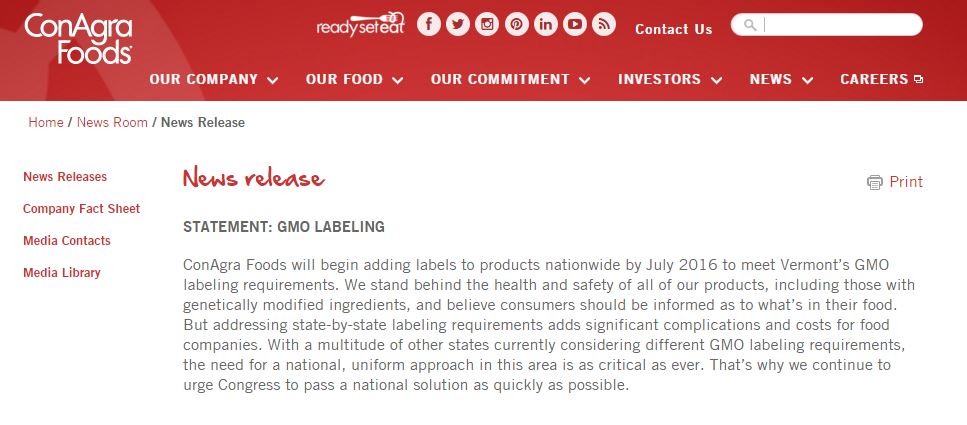
Press releases have started to surface showing that is the stance food manufacturers are already taking including ConAgra Foods, General Mills, Kellogg's and Mars.  They will label all GM products and the business decision is sound.  If they only label in one state then they will have to increase costs to consumers and they don't want to do this yet.   They are being forced in a corner, but I am happy to see they all still stand firmly behind the science.  They all believe in biotechnology and GM food.   They know it is safe.   Take a look.


http://www.mars.com/global/press-center/gmo.aspx


Labels imply different

 A GMO label on a product implies that is a GM food is fundamentally different from its non-GMO counterpart.  And let's be honest, that difference is an implied danger.   Do you notice a trend in the food manufacturer press releases:  "we stand behind the safety," and "GMOs are not a health or safety concern". The GMO labeling hype is because people think GMOs are unsafe and want to see how to  avoid them.    A GMO crop was indeed engineered with one or maybe even 5 genes.  The DNA that encodes that gene is precisely sequenced and known down to every base pair.  That sequence is run against allergen databases.   It is tested for years in all kinds of studies.  The results of those few genes are tested and then tested more for safety.   When you conventionally breed crops to introduce a new cultivar you are changing and introducing hundreds of new genes.  But corn (or insert any crop) is corn right?.  Take a look at what conventional breeding did with corn and think about the thousands of genes needed to make that change.  There are NO labels when food from a brand new cultivar is released in the grocery store from conventional breeding.


http://voices.nationalgeographic.com/2009/03/23/corn_domesticated_8700_years_ago/


The sad thing is the GMO labeling issue at the federal level was heading in the right direction in my opinion.  The bill H.R. 1599 Safe and Accurate Food Labeling Act had passed the House, but is stalled in the Senate.  This bill states (https://www.congress.gov/bill/114th-congress/house-bill/1599):

Subtitle A--Food and Drug Administration
(Sec. 101) This bill amends the Federal Food, Drug, and Cosmetic Act to require the Food and Drug Administration (FDA) to continue the voluntary consultation process established under the FDA’s "Statement of Policy: Foods Derived from New Plant Varieties." In that process, the FDA evaluates a scientific and regulatory assessment provided by the developer of a food produced from, containing, or consisting of a plant that is a genetically engineered organism (GMO).
The FDA may require a GMO food to have a label that informs consumers of a material difference between the GMO food and a comparable food if the disclosure is necessary to protect public health and safety or to prevent the label from being false or misleading. The use of a GMO does not, by itself, constitute a material difference.

The bill states it exactly right:   "The use of a GMO does not, but itself, constitute a material difference,"  anymore than a new plant variety.  However, the Vermont bill will imply there is a difference.

Consumers are going to be even more confused

Consumers are emotional and can change opinions from reading one false Tweet or Facebook post.  When it comes to GMOs, I think many consumers are confused.  This isn't a jab at consumers.  I think there is a "fog of war" when new technologies come out.  It takes a while for consumers to learn about the product and for it to find acceptance, but this particular labeling in Vermont is not going to help this cause.  A survey I found from 2014 shows some US public perception.  Take a look http://www.pewinternet.org/2015/07/01/chapter-6-public-opinion-about-food/

If we dive into the survey we see that 67% of US adults generally think GMOs are unsafe.


The second graph shows what happens to that view as education level goes up. As education level goes up, safety concerns by US adults goes down.  This tells me that the biggest problem we have with GMOs is education.  We need to get the science out to the consumer.  A GMO label does not educate but sows more confusion especially when every state is trying to introduce its own individual labeling law.


In ending I could not sum it better than a farmer in Iowa.  Read the opinion in full, but here is great synopsis:

"Consumer confusion
This is a recipe for bewilderment among consumers.
Moreover, these laws are bad on the merits. GMO foods are safe and healthy. They don’t need warning labels, as organizations ranging from the American Medical Association (AMA) to the National Academy of Sciences (NAS) have said.
I don’t know about you, but I’d rather entrust my food labels to the experts who work at the FDA and listen to the advice of the AMA and the NAS — and not to a few politicians in Vermont.
Labels should educate, conveying reliable information rather than propaganda. We must honor their basic purpose, not let them become marketing devices for favored groups."
Full post found at:  https://www.iowafarmbureau.com/Article/Mandatory-GMO-labeling-is-a-recipe-for-consumer-confusion


Monday, March 28, 2016

Scouting: Making fire without matches

I recently went camping with the cub scouts and one of their requirements was to start fire without matches.  I had to brush up on my knowledge to make sure I could even start a fire without matches.   Flint and steel in my opinion is the easiest way to get a spark and thus a fire if matches or a lighter are not a possibility.   Modern "flint" that is an alloy is actually a little better than real flint and is found anywhere that sells camping gear.


Artificial flint

The spark is the easy part; getting the spark to turn into a fire is the hard part.  That is where the "tinder" becomes important.  There are three tinder's that I wanted to show the boys that can easily go into your survival pack.  You can always make a tinder nest out of pine straw, leaves, dry grass, etc., but carrying these can things much easier.

1.  Cotton Balls
2.  Steel Wool
3.  Char Cloth

Cotton Balls

I think this cotton balls are probably the easiest to find and use. Just fluff the cotton ball up real good and throw a spark on it.  To make it even easier, rub petroleum jelly on the cotton ball.  A small tube of the petroleum jelly is easy to carry in a backpack, but if you don't have it a cotton ball all by itself will do just fine.

Fluff the cotton ball (on the right)

Get a spark on the cotton


Steel Wool

Steel Wool is amazing stuff because once a spark catches hold of it, the entire thing of steel wool will turn into one big ball of hot metal.  Steel wool comes in different types from course to fine.   Use super fine steel wool for the easiest path to a fire.  Small fibers of steel wool will break off and give you a splinter so be careful.  However, the advantage is even if your steel wool gets wet just ring it out and it can still be used as a fire starter.


Use super fine steel wool when possible

Get a spark on the steel wool

Blow gently to really make the wool get hot


Char Cloth

This is one my dad showed me when I was a kid.  I had to look up how to make it again.   If you have an old cotton t-shirt just cut it up into squares.  Throw the squares of cloth into a metal tin.  An old Altoids candy tin or similar container works well.  I used a small evaporated milk can.  A soup can or any metal can would work.  Remember to remove the paper label.  If you have a tin with a lid place a small hole in the lid.  If you have a soup can then place aluminum foil as tight as possible over the top and poke a small hole on the top of the aluminum foil.  Now just place the can on heat.   A bed of coals from a fire works the best, but other hear sources will work fine.  I made some of the grill.  I had to place the can directly on the burner shield instead of the grill grate so I could get it hot enough.   After 10 minutes or so a billowing column of smoke will start to come out of the hole.  When the smoke stops coming out the container then you are done.  You will be left with charcloth, a slow burning fuel.  It is now a blackened material that can easily catch a spark.  Throw a spark on the cloth and then you can lightly blow on the cloth to make the spark spread and eventually get your fire going.

Closed metal tin with a lid (add a hole to the lid)

Charcloth

Gently blow to make the cloth get hotter


Once you get one of these tinder types lit with a spark, the rest is just building up bigger and bigger twigs until you get fire.  So next time you you forget your lighter, don't worry.  If you can make a spark, then you can make fire.


Spark onto steel wool = FIRE

Monday, March 21, 2016

Astrophotography: Comet Lovejoy C/2014 Q2

There are those vivid memories of childhood that are just as clear as they happened yesterday.    I have one of those memories from growing up that I think it part of the reason I love space.  I was a kid and my dad took me out on a night adventure.  We had a creek that ran through the farm and once a year these large sucker fish would would swim upstream to spawn.  We would put on waders, walk up the creek with our flashlight and go fish gigging.   That was fun, but that one spring as we finished gigging and came out into the open field a large comet was visible in the sky.  I remember it being spectacular.  The tail took up almost half the sky.   Halley's comet had come when I was in second grade and I don't really remember it.   So this was my first experience with seeing a comet.  I don't even remember which comet it was, but it was stunning.   I had never seen something so beautiful in the night sky before.

Years passed and just recently I was so ready to see comet ISON when it got all its hype as the "comet of the century."  Yet that one basically disintegrated as it made it trip around the sun in 2013.  So then out of the blue, I was seeing amateur astronomers taking pictures of Comet Lovejoy C/2014 Q2 last year.  The comet gets is name from Terry Lovejoy who is the guy that found the comet.   By the way, he has discovered five comets so far that are all named after him.

I had to try my luck at getting a picture.  This comet was not going to be like the oneI saw as a kid and take up much of the night sky.  However, with a telescope some very nice pictures were taken.  I never got a spectacular picture, but I was happy I did get something.  It is the first comet I had ever tracked in the night sky with my telescope and so far the only one I have taken a picture of.   Comets are a little tricky since the the they are moving differently than other deep sky objects.  The basic process is still the same.  I take multiple exposures of the comet as I track it and then stack all those pictures together to get one final photo.  I processed the data two ways.  In the first processing the comet itself is the focus and the stars are blurred.  Each frame the comet had moved so much that the stars are in different locations and so while the comet is stacked together the stars are not which is why the stars form streaks in the picture.  .  The second processing took into account the comet location and star location in each frame and stacked them together in the same locations.  The software that does this did a really nice job, but it was still time consuming since i had to manually mark the comet's nucleus in each frame to give the software a frame of reference.


Processing taking into account just the comet location

Processing taking into account comet and star location 


Comet Lovejo C/2014 Q2 ended up giveing a very nice tail.  My pictures only show a hint of what is really there.  Take a look at some of the professionals to really see the beauty of this comet when it was visiting.  It gave off a green/blue light as the sun heated it up.  There were at least 21 organic molecules coming off the comet in gas form including sugar and ethanol!

Hopefully another comet will come visit us in the near future, but this one won't be back for 8000 years!  No one on Earth will see this one again for quite some time.

Monday, March 14, 2016

Making it Personal: Show your support for GMOs


As as I was looking into the petition to take GMO ingredients out of Girl Scout cookies I had a revelation.  Actually it wasn't even a revelation, but more of a confirmation.  A confirmation that GMO supporters are not as strong in the grassroots initiatives like the anti-GMO supporters.  The girl scouts petition was a perfect example.   A girl scout put her voice against GMOs on the site change.org and received over 47,000 signatures to date.  It was enough of a voice to get her an audience with the Girl Scouts.  The Girl Scouts organization still listened to science and kept GMO ingredients in their cookies, but I can guarantee that petition pushed someone that was on the fence to think GMOs are dangerous.  Decisions based on a emotions happen to all of us at some point.  A good story can capture our hearts whether it is based on a true story or not.

The biotech industry pushes out facts and brochures in an attempt to educate the public.  Scientists talk about their research to their friends and neighbors.  The education effort must not stop, but in my opinion this is not enough.  The anti-GMO movement in many cases is using false information, but it doesn't matter if that story grabs someone by the heartstrings.  It is a personal story and people are emotional beings.  A story captivates much more than bars and graphs for many people.  The pro-GMO movement is not making it emotional, at least on the same scale as its opponents.  That emotional grassroots movement is what we need.  

I went to change.org and searched GMO.    Here is a nice excerpt of what is shown:


I know that lots of people already have their mind made up.  There is a group that will not be swayed and many of them will support these types of petitions.  Yet, don't be naive to think these types of tools on the internet don't also persuade people that are on the fence.   These petitions are from people that feel so strongly about there view that they try to persuade other's to share the same viewpoint.   Where are the same stories from a from a pro-GMO view?  They almost non-existent.

I know we have science on our side.  The safety record of GMOs is impeccable and the benefits are well documented, but almost everyone in Europe vehemently opposes GMOs.  Even in the US there is some opposition. We have to make this emotional and take the battle to the front lines on a personal level.  The science by itself is not enough.  Just use Europe as a case study.  People need to connect to the science emotionally.

I made a change.org petition to support GMOs.  Show your support.  Show other's that feeding the world and making better tools for the farmer's is not just a job for us.  It is a personal mission.   We want to make a difference in the world.  I please with you to go to this link, sign you name and show your support for GMOs.  Even write a comment and share your story.  We can change the culture even if it is one person at a time.  We have to try.

Click to sign: Support the science based benefits and proven safety of GMO crops to feed a growing population


Monday, March 7, 2016

Girls Scouts: I love those GMO cookies

I work at Bayer CropScience and as you might expect we talk about GMOs and public acceptance quite a lot.  I get a lot of ideas from interactions I have with the friends, family and even strangers when the topic of GMOs come up, but my colleagues at work feed me a lot of ideas too.  It was just the other day that we were talking about GMOs at work when someone brought up the girl scouts.

I love scouting.  It is a wonderful program designed to teach kids valuable skills and develop them into leaders.  I have two boys that actively participate in cub scouts and I have enjoyed being a den leader as well as going through the ranks of boy scouts when I was a kid.  However I have not had much experience with girl scouts.  I have a daughter, but she is still too little to be involved.  That does not keep me from buying the infamous girl scout cookies when they come knocking on the door.

http://www.abcsmartcookies.com/thin-mints


So what do GMOs and the Girl Scouts have in common?  Well, my respect for the organization grew even more when I started fact checking the connection myself.  The truth is those girl scout cookies that I love so much are made with GMO ingredients and the Girl Scouts have not changed that stance even with pressure to do so.

The cookies use GMO ingredients but there has been plenty of pressure to switch to all non-GMO ingredients.  A petition was started in 2013 by a girl scout to get the Girl Scout organization to stop using GMO ingredients.  The Facebook page is still going strong and the petition has over 47,000 signatures.


I was hunting for the reason why the girl scouts are being petitioned to remove GMO ingredients and found the letter describing the anti-GMO position.


This letter sums up the information war that sadly anti-GMO groups are winning and the misconceptions that the industry is having a hard time changing.  Let's look at this letter in depth.

1.  "If Girl Scouts continues to make cookies with GMO ingredients, our soil will continue to be saturated with pesticides"

GMOs in many cases help decrease the use of pesticides.  Quoted right from the publication Science, "Overall pesticide use on U.S. farms dropped 0.6% a year from 1980 to 2007."   Bt corn is a prime example of a product whereby insect eat the plant and die so less pesticides need to be applied.


http://www.sciencemag.org/site/special/pesticides/infographic.xhtml

2.  "Our Farmer’s will continue to pay higher prices for seeds and purchase larger quantities of pesticides."

It is easy to say farmer's pay a higher cost for GMO seed, becuse at face value that is correct.  However farmers are more than willing to pay a higher cost for GMO seed because the yields and thus the profits are higher.  I really encourage you to read this article:  https://gmoanswers.com/ask/what-difference-cost-production-gmo-vs-non-gmo 

 I can summarize just a small part of this issue from that link.  

A farmer in Maryland has grown GM and Non-GM corn and soy and run the numbers.


GMO seed does indeed cost more.  There are research costs associated with new technology.  A lot of scientists put in hard work and time to bring a better solution to the farmers.   However look at the gains.  Income per acre is much higher because the GM solution provides higher yield.    Delve into the article for even more comparisons and perspective.   Even more important, talk to farmers about GMOs and see what they use and think.  Get their perspective and you may be surprised that most farmers want new biotech solutions if it means higher yields.

3.  "Our bees will continue to die off."

There is no dispute that bees are dying off.  The issue is complicated because there is not just one thing killing the bees.  Instead there are many factors and they are all coming together.  Climate change and the parasitic varroa mite are all part of the issue.   Certain pesticides if not applied properly can kill bees.  And now hot off the press is more research that was just published in Science that shows a virus called the deformed wing virus may be part of the problem too.  We know the varroa mite can pick up viruses from the bees blood and transmit it to other bees.  If the varroa mite and deformed wing virus are in the same hive the results are dead bees and estimates are that the two have joined to kill millions of bees.  Bee death is a challenge we must solve, but no where in this discussion is anything about GMOs killing bees.  In fact GMOs may be a tool to help protect bees from insecticide use.  If less insecticides are used due to GM technology there is less risk that insecticides are used improperly and will kill bees. 

Take a read on the new science:  http://www.ibtimes.co.uk/bee-decline-two-diseases-are-combining-destroy-global-honey-bees-1547415


4.  "In eating the cookies we will continue to gamble with our health."

I have shown and talked about GMO safety in many previous blog entries.  Take a look back at the science.   This info graphic sums up safety quite well.  GM food is safe and we have the science to prove it!


http://www.foodinsight.org/biotechnology-gmo-food-safe-who-infographic


5. "Please research GMOs thoroughly and understand no long-term studies have been done."

Yes, please really research GMOs including the "1783" studies that have looked at safety.  Research the benefits including higher yields and less pesticide use.  Research projects like Golden Rice (GMO rice with increased vitamin A) and the humanitarian efforts that GMO crops can provide the world.   Talk to farmers and get their perspective.  Talk to scientists doing this work over dinner and see that they are trying to make a difference.  There is no corporate conspiracies.  We love science, we love agriculture and we want to provide farmers with a tool to help feed people.

In the end the Girl Scouts did do their research and listened to the science instead of the fear.   Their stance is listed on the Girl Scout website.  So when the Girl Scouts come to my house next time I might just have to buy a few extra boxes.

http://www.girlscouts.org/en/cookies/all-about-cookies/FAQs.html