Monday, June 12, 2017

Astrophotography: M13


A beautiful clear night in May put me in the mood to take some pictures.  I originally went out to take a picture of a comet that is currently in our skies and I am still working on that image.  That comet is proving difficult to process.   I had a little bit of time left that night so I also snapped a few shots of another target that was in close proximity to the comet.  It is called M13 and is a globular cluster of stars located in the constellation Hercules.  A globular cluster is a collection of stars in a tight spherical formation.  They are quite common with over 150 of them known just in the Milky way.

M13 is a beautiful globular cluster with hundred of thousands of stars.  Just to put size into perceptive, the diameter of this ball of stars is 145 light years across and it is 24,100 light years away from Earth.

M13 was cataloged by Charles Messier in 1764, but first discovered by Edmond Halley in 1714.  Halley is most notably known for determining the orbit of Halley's Comet.

The most interesting fact for me is that M13 was chosen as the target to beam  the Arecibo message.  Taken straight from Wikipedia, the Arecibo message that was sent in 1974 contains the following info:

Dr. Frank Drake, then at Cornell University and creator of the Drake equation, wrote the message with help from Carl Sagan, among others.[1] The message consists of seven parts that encode the following (from the top down):[4]
  1. The numbers one (1) to ten (10) (white)
  2. The atomic numbers of the elements hydrogen, carbon, nitrogen, oxygen, and phosphorus, which make up deoxyribonucleic acid (DNA) (purple)
  3. The formulas for the sugars and bases in the nucleotides of DNA (green)
  4. The number of nucleotides in DNA, and a graphic of the double helix structure of DNA (white & blue)
  5. A graphic figure of a human, the dimension (physical height) of an average man, and the human population of Earth (red, blue/white, & white respectively)
  6. A graphic of the Solar System indicating which of the planets the message is coming from (yellow)
  7. A graphic of the Arecibo radio telescope and the dimension (the physical diameter) of the transmitting antenna dish (purple, white, & blue)
Since it will take nearly 25,000 years for the message to reach its intended destination (and an additional 25,000 years for any reply), the Arecibo message is viewed as a demonstration of human technological achievement, versus a real attempt to enter into a conversation with extraterrestrials. In fact, the core of M13, to which the message was aimed, will no longer be in that location when the message arrives.[1] However, as the proper motion of M13 is small, the message will still arrive near the center of the cluster.[5]


The technical card of the image I took.   There are some other small galaxies in the picture, with NGC 6207 being the most noticeable.


Thursday, May 25, 2017

Bayer CropScience meets Research Triangle High School


I will preface this entry with the fact that I work at Bayer CropScience but as this is a personal blog, these are my own viewpoints and perspectives.  
I have come to learn that one thing I always look forward to these days is when I get a chance to work with our younger generation on scientific outreach.  I do outreach to help people understand what Bayer does.  I also do outreach because it is an opportunity for people to understand who we are at a personal level and for me to understand their personal ideologies.   I and my colleagues work at a big company, but we are people just like anyone else.  When people get to know us and we get to know others, the conversation becomes much more interesting and productive. 

 Many times this outreach is showing elementary kids how to isolate DNA from bananas or letting middle schoolers participate in a pH experiment.   We use fun experiments like making slime to explain to kids the science behind that fun.  However when you start working with high school students you can go beyond the simple experiments.  Not only can you go deeper into the science but you also realize there is a lot they can teach you.
We have so many people committed to outreach and doing such great things to engage our community.   This is just one example to share a great experience we had at work with some very gifted high school students.   The team I work with at Bayer is called the Plant Genome Engineering Group.  This is just a fancy way of saying we are the group that makes transgenic (GMO) soybean plants.   We wanted to do an outreach activity together were we share who we are as scientists and engage some students to understand our industry and what we do.  Most importantly we wanted the conversation to come down to a personal level.

We invited 29 students from Research Triangle High School, a local high school here in central North Carolina to come to our site located in Morrisville, NC.  Our goal was to:

1.)    Let the student’s network with scientists and get to know us on a more personal level. 

2.)    Learn more about the students and who they are.  What are their concerns and their ambitions?

3.)    Teach the students about our industry and what it means to take a product from start to finish.


We have some awesome folks in Bayer, one of whom is named Dean.  He and a team had already established a very in depth case study called NXGen AG.  The case study involves a team of students choosing a GMO product concept and making all the choices needed to get that product to the finish line.  These choices include a product concept, how many field trials, how to source protein production, how to handle seed production , what market share to target, and what type of market growth to target.  These were just a few of the decisions the groups need to make.  Each group of students worked with a couple of scientists to understand what these choices are and then decide on how to proceed. 


Watching the scientists and students interact over half a day was a joy.  Both groups were engaged and asking each other questions.     The room was full of chatter:  Why does the protein that kills the pests not hurt humans?  Or maybe it was the scientist asking, where are you going to college and what do you want do when you graduate? 


At the end of the case study each group was able to present their  product concept.  Here they were:

 
“NWW-492”

A soybean plant with enhanced water efficiency to grow better in drought conditions.


“Shut-Up” 

A soybean with increased yield.


“FortiSoy”

Soybean that is resistant to pests such as catepillars.


“Gen Shield”

Soybean that is resistant to pests such as caterpillars.


“DripDrip”

A soybean plant with enhanced water efficiency to grow better in drought conditions.


At the end of the day, each team presented their concept, why they would market this product and what they learned.   I feel that this case study does help put into perspective the decisions we need to make as well as the time and effort that goes into a product.  It also shows that when dealing with Biology, nothing is a given.  For instance a field trial that is hit by a flood can put your product back one year. 

It was a joy to work with the school and students and I look forward to the next interaction with our community.  Even more inspiring is getting the notes from the school and students.

From the school and students:


·         We wanted to send our thanks to you and the team at Bayer for the wonderful experience you hosted for our students last week. One of the parents told me that the kids didn't stop talking about the trip the entire drive back to school, and I heard really positive feedback from all of my students.  

·         Thank you so much for spending your day with us! It was really interesting to tour the labs and especially to do the case study.  I really appreciated your talking through each possible scenario at each of the different steps so we completely understood what could and did happen throughout the process.  I was also really thankful for the time you took to answer our questions, no matter how complicated they were.  It always felt like you were speaking to the group as though we were your equals, and that meant a lot. Thank you again for taking the time out of your day to work with us, and I hope you have a lovely day!

·         Thank you for the wonderful experience you provided for my group during our school’s tour to Bayer.   It was really insightful from our conversations to see exactly what stance GM specialists have on GM critics. It was mind blowing to learn just how many safety tests are required in order for a GM product to reach the market. Also, thank you for walking us through and letting us experiment with the case study. It was really interesting seeing how you always tied things that we did within the case study to real examples you have encountered at work. 

·         Thank you for allowing us to come in and work with you guys!  The trip was very informational, interesting, and intuitive.  I enjoyed working with you guys and the activity was structured very well. I think you guys did a fantastic job explaining things as well as allowing our group to think for ourselves and make our own decisions.  I appreciate the work you do at Bayer and hope that this partnership with my school continues for future classes to see and experience what I did.  

·         This trip opened my eyes to the positive side of GM technology and benefits that can arise from it.  I like how in depth the explanations were when we asked questions and you did a fantastic job keeping the group on task as well as helping us manage our time. This trip taught me about the time consuming task of introducing, researching and developing, and marketing new gm products.  Thank you again for allowing us to come and spending time with us.

·         I really enjoyed coming to Bayer’s Crop Science. It was a great learning opportunity  for me as an AP Biology student. I enjoyed being able to see the technology that is used to develop GMOs. I also liked being able to see what Bayer’s Crop Science actually does. Prior to this trip, I had never heard of Bayer. I think it was cool that y’all’s company decided to reach out to a group of high school students in order to share what all you guys actually do. It was fun to be able to go through a series of real-life scenarios and have to make decisions that would actually have an impact of the economy, world of crop science, and business.

·         When I get older and get out of college, I plan to be a businesswoman. I think this was a very cool and educational experience that allowed me to see a little bit what the business world is like. Giving our pitches to an actual board of scientists was fun. I enjoyed the way that they gave feedback. They informed us of what we did right and what we did wrong. Thank you for being the leader of my group and helping us to enjoy and be informed during our time at Bayer.

·         Thank you for spending your day with us at Bayer. I certainly learned a lot about how your company functions as well as the crop science industry. It was very interesting to learn about the entire process of creating a product and putting it on the market through the simulation that we did. It was a pleasure working with you guys and the rest of our group, and it was a great surprise to win the ‘competition’ for the investment!

·         I really appreciated your patience and willingness to answer questions or go in depth about any sort of topic throughout the simulation. It really shows how passionate you are about what you do at Bayer. I wish you success in your work and have a great day!

·         Thank you so much for spending your morning with us and being helpful to our group during the exercise. Your knowledge and expertise helped my group make informed decisions on the economic and biological situations that can occur when marketing a GMO product. This experience was amazing for me thanks to the both of you, and I have a better understanding of how biology is linked more closely with business. Thank you again!

Monday, May 8, 2017

FDA to use 3 million for consumer outreach regarding agricultural biotechnology

It was announced that the FDA would get about 3 million dollars to help counter some of the mis-information around the topic of biotechnology.

Here is a quote from the Washington Post describing the allocation of $3 million dollars:  

"The deal to avert a government shutdown, which passed the Senate by a vote of 79 to 18 Thursday, allocates $3 million to “consumer outreach and education regarding agricultural biotechnology,” which includes genetic engineering of food and commodity crops. The money is to be used to tout “the environmental, nutritional, food safety, economic, and humanitarian impacts” of biotech crops and their derivative food products."

It is unclear exactly what this program will look like or when it will be rolled out, but since it has been announced there has been a lot of chatter from supporters and opposition alike.  The opposition of the outreach initiative wonder why the government is doing the teaching instead of the regulating.  

I on the other hand am a big fan of such an initiative.  I have posted many blog entries citing scientific references on the safety of GMOs.  However the anti-GMO groups have put so much mis-information out there that it is easy to get confused on what is fact and what is fiction.   While I do believe that the industry needs to do its part in education, I believe there is nothing wrong with the government educating as well.  In fact our agencies already have some great programs to educate people on all sorts of topics.  Why should we get upset about them trying to counter mis-information on GMOs?  

The Washington Post already has 292 comments on the article about the FDA outreach program.
https://www.washingtonpost.com/news/wonk/wp/2017/05/03/the-government-is-going-to-try-to-convince-you-to-like-gmo-foods/?utm_term=.8694cdfb2531#comments


Here are some educational programs by the EPA.  I do not see any major outrage at these resources the government is spending to sponsor these educational programs:  https://www.epa.gov/education


The FDA also has plenty of outreach and educational programs already out there.  Just go to their site and take a look.  Here are a just a couple:


I do not think there is any argument that these agencies should not be doing outreach.  Even the EPA  show on their site that education is what increases public awareness and knowledge as opposed to just information that provides facts and opinions.   Education is what separates the facts from the opinions.  


https://www.epa.gov/education/what-environmental-education


The other point is that the wealth of mis-information really does need to be countered.   I picked just a few comments to show there is a good reason to get the facts out there.


Let's try again with the facts:


https://www.geneticliteracyproject.org/2015/01/29/pewaaas-study-scientific-consensus-on-gmo-safety-stronger-than-for-global-warming/

Here is another:

???   I don't even know what to say to this one.  I am not sure I could make up something this good.  I surely can't find anything about GMOs killing anybody ever.   I did find one nice snopes.com article about the rumor of the 1st person dying from a GMO tomatoes which of course is FALSE.

http://www.snopes.com/media/notnews/gmodeath.asp

In closing, one comment really summed it all up for me.  The question for you to answer is "Which is it?"


Monday, April 24, 2017

STEAM night: Showcasing Science, Technology, Engineering, Arts, and Mathmatics

It's always great to see schools, organizations, parents, and kids engaging in STEM activities.  I was able to participate and see such a great event this past week.  It was STEAM night organized by Laurel Park Elementary School.  I had fun engaging the kids, but there were  a lot of other great exhibitors!  I thought I would show a little information about the ones I able to see.


Here are a few details about some great folks and programs that are helping to educate our kids for the future.

Happy Little Circuits

I wish I knew more about robotics.  Well this group of kids not only knows about robotics, but they build them.   Happy Little Circuits is a robotics team from Apex High School.  They had some robots on display to interact with the kids.  There website is http://apexroboticsfirst.weebly.com/


Why is it important to teach our kids about robotics?  Here is an article from a local newspaper just the other day.


North Carolina Air Quality

The NC Air quality was available for questions.


The booth had a neat little craft to collect pollen from the air.


Space

One of my favorite subjects is SPACE!!   And there was some great information on constellations and observing the upcoming solar eclipse.

Did you know there will be a total solar eclipse for much of North America on August 21, 2017.   NASA even has a page dedicated to this event.  Check it out!

https://eclipse2017.nasa.gov/


The booth also had handouts on how to look at the eclipse.


The Little Medical School

The little medical school is all about bringing medicine, science, and the importance of health to children in entertaining, exciting, and fun ways.   There is more information at their website:

www.littlemedicalschool.com


Treasure Quest Mining 

Treasure Quest Mining is a mobile gem mining and treasure hunting experience.  They were at STEAM night showing off all kinds of rocks to interested kids.


Academy of Engineering and Advanced Manufacturing

The Academy of Engineering and Advanced Manufacturing is a learning community within Apex Friendship High School.  The academy introduces students to career opportunities within STEM.


eMammal

This was one of my favorite booths.  There is a program called eMammal that can be used by anyone to collect pictures of animals for the Smithsonian


A local middle school had participated in the program.   After hearing about this program I really want to join in the fun.  If you are interested be sure to go check out the eMammal site.

https://emammal.si.edu/


BounceU

BounceU is a bounce house for kids.  However they run robotics camps as well for kids.    They had a robot on display.


NC Fossil Club

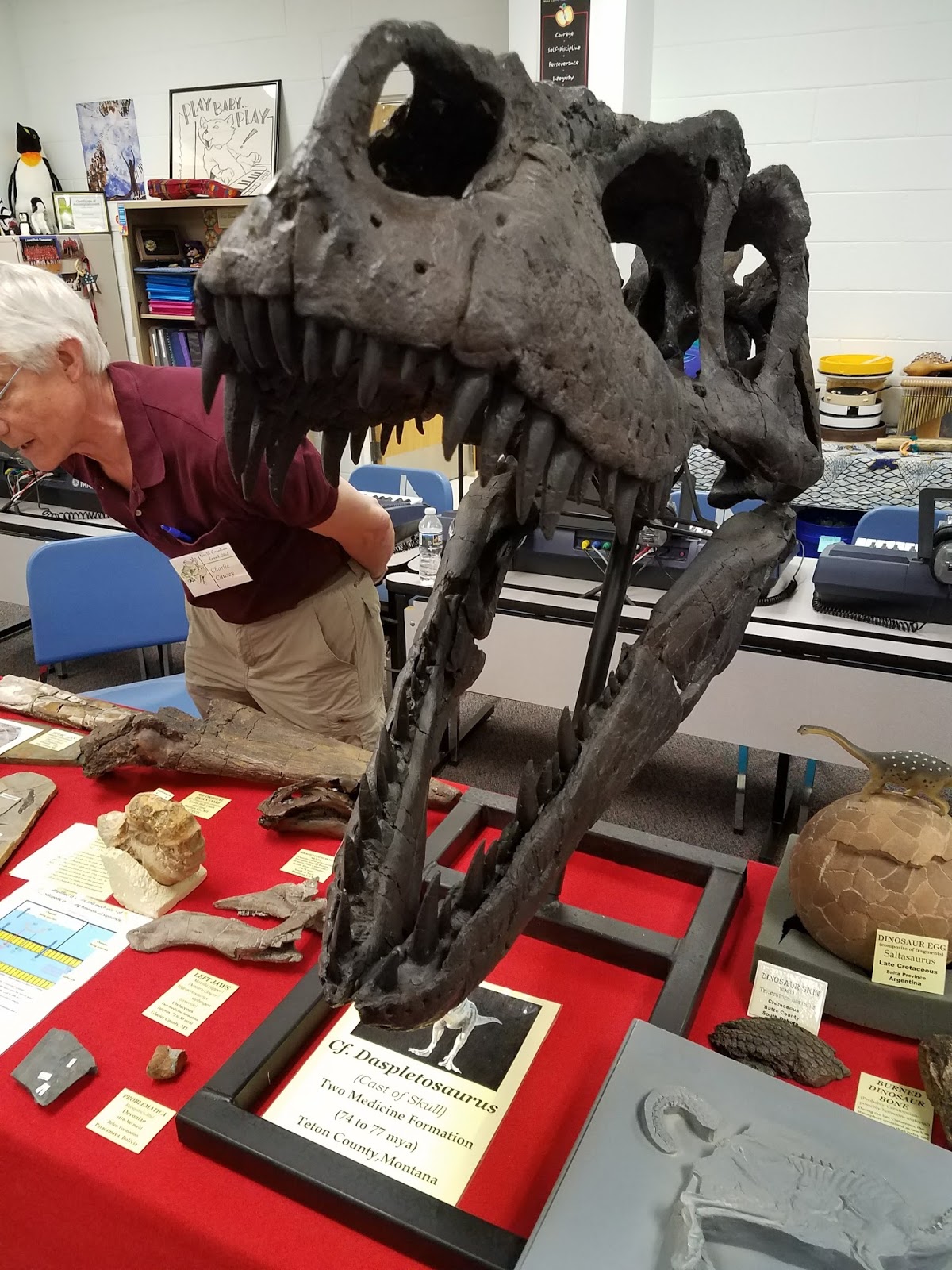
Did you know North Carolina had a fossil club?  I did not either.    Some representatives from the club were there to share and show off some fossils.   If you want to learn more you can visit their website:

http://www.ncfossilclub.org/


Laurel Park Elementary School

Laurel Park was getting in on the action by demonstrating how to make a battery from fruit.   I have an earlier blog post showing off how you could do this activity yourself.


Beekeeping

A local beekeeper was showing off what it means to have your own beehives.


RoboEagles Team

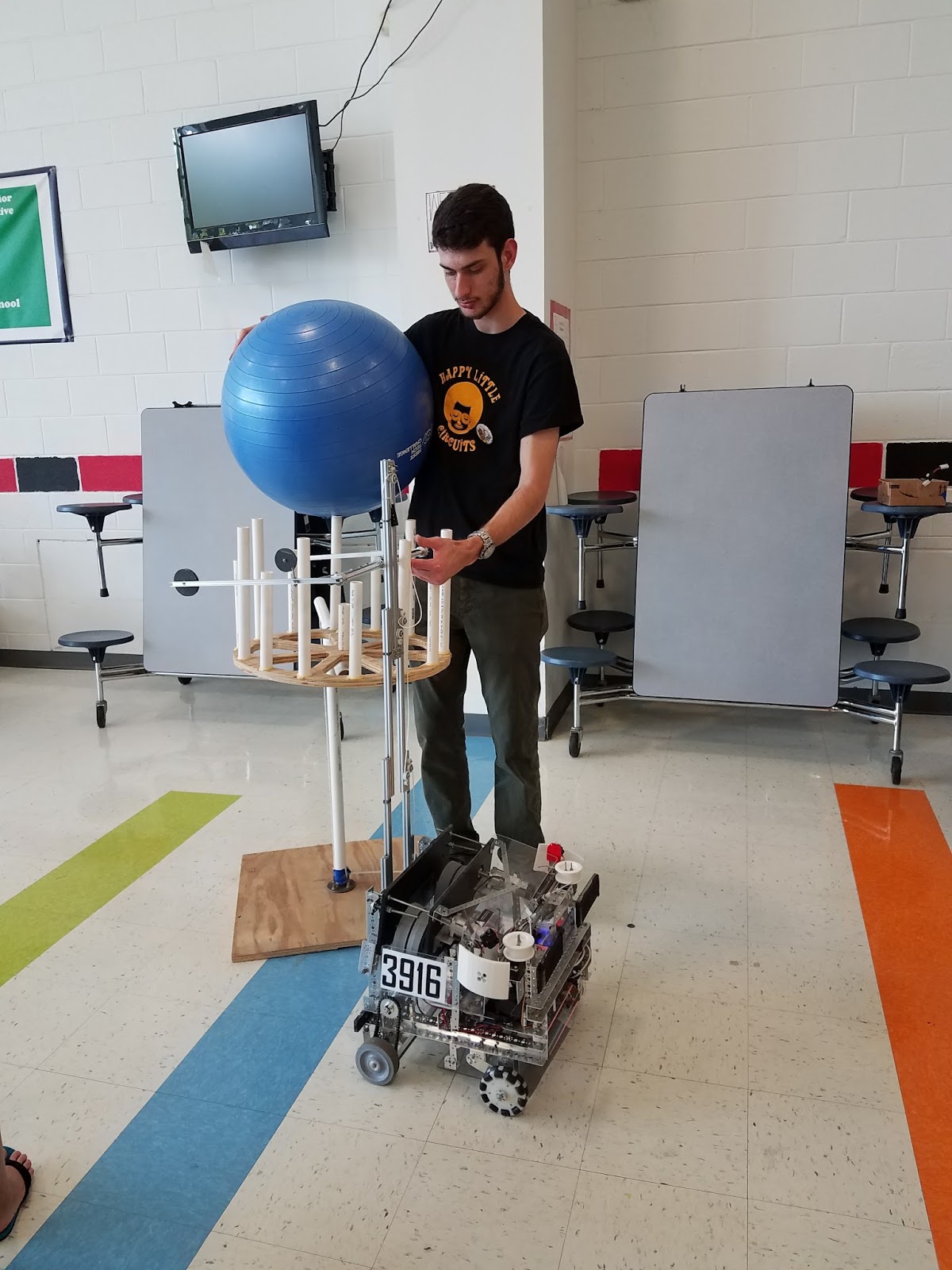
The RoboEagles Team is a fifth year robotics competition team that was showing off their robots.  They had a robot on display that threw a large ball.  The kids had a chance to try and catch a ball thrown by the robot. 

Their website is here where you can see exactly what their robots look like:


NC State Entomology Department 

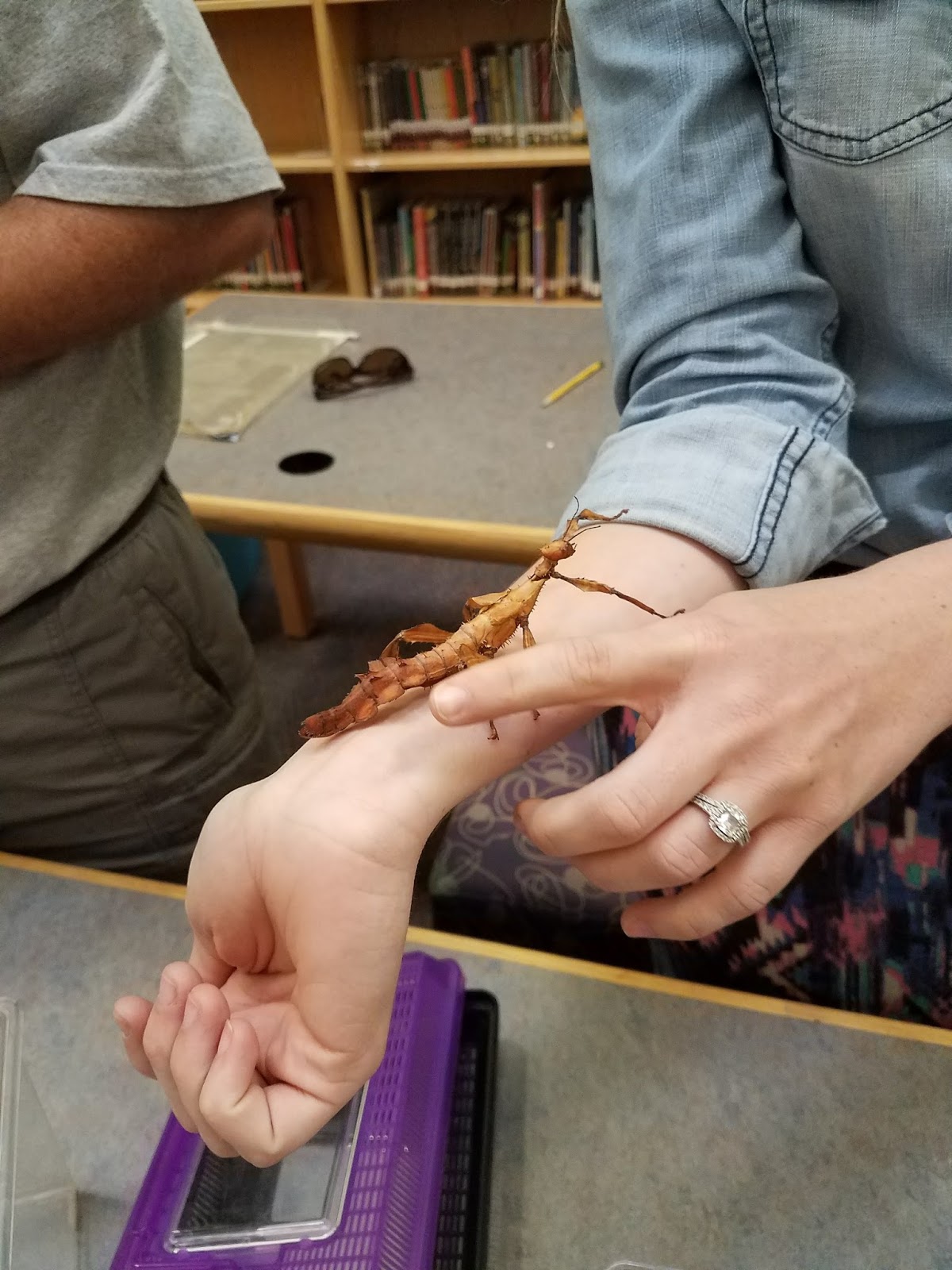
Do you like bugs?  Well there was an NC State entomologist on hand to show off some really cool bugs.    Here are a few of the ones on display.


Here are a few of the ones on display.

A Madagascar Hissing Cockroach and Vinegaroon.   The vinegaroon sprays acetic acid which smells like vinegar!!


A Thorny Devil


Tarantula
 Cave Cockroach


DNA Extraction


And finally I was around to extract DNA with kids and teach what DNA is all about.   We demonstrated that even plants have DNA!  In 2 hours we did over 50 DNA extractions!


I probably missed a few booths at STEAM night.  There was just so much to see and do in only 2 hours.  I really applaud Laurel Park Elementary and all the other schools and organizations that took to show off what they do.  Just as important are the parents that volunteer to help out or bring their kids to these type of events.   That time will translate in helping many kids better understand some of the opportunities available to them the STEAM area.  It was a great night and I look forward to the next one.

Monday, April 10, 2017

Brewing Beer - Berliner Weisse

I wanted to share beer brewing experiences, at least when the beer turns out to be good.   :)   This was one that a friend and I worked on on the end of 2016.  Kirk is the real expert here and so I learned a lot from this brew.  He asked me what I wanted to brew and I said can we brew a sour beer.   This is how we did it.

First we need to do a little prep work.  Keeping everything clean is super important.  Star San is a great sanitizer for surface sanitation.  The great thing about this product is you do not need rinse it off.  Just soak your equipmen or dip your supplies in a solution of this stuff and  you are good to go.


We also want to get rid chlorine and chloramine in our water.  So adding campden tablets to our water will take care of this.  


Next we need to get our water boiling to get it good and sterile.  This will be a 5 gallon batch of beer and we are going to go ahead and boil all 5 gallons.  Having a pot with a temperature gauge is very helpful.  Just don't watch while waiting for a pot to boil.  It will go much slower!


 Once we get a good boil we can pull the pot off the heat and add the extract.  For this beer we are adding 6 pounds of Munton's Plain wheat extract.  This extract is 55% wheat and 45% barley.


 Once the extract is added we need to stir to make sure it is dissolved well.  We also don't want it to  stick to the bottom and burn.


Finally we need to cool the wort to ~ 120 degrees Fahrenheit.  What makes this beer different than other beers is we have this extra souring step.  Normally we would boil some hops, cool, and pitch our yeast.  In this case we need to "sour" the beer.  A bacteria called Lactobacillus can be added to our wort and will start eating the sugars.  In this process it is souring the beer and giving the flavor we are looking for.  This bacteria likes to grow between 100 and 120 degrees F and so we need to cool our wort to this temperature.   We used a copper coil to get the temperature down.  Kirk had a little sump pump to help pump water through the coil and back into the sink.


Once the temperature is down to the correct place, we need to get some Lactobacillus into our wort.  This can be accomplished in a number of ways.  You can buy cultures.  A cheaper way is to buy some wheat grain and throw them into your wort.  Wheat naturally harbors Lactobacillus and is a great way to introduce Lactobacillus.  A couple hand fulls should be good.


Now we need to create an environment where Lactobacillus grows well and where "bad" bacteria cannot out compete the Lactobacillus.  We need to give the wort a cover since it will be sitting here for a few days.  Se-ram wrap works great.  Get a thick and tight covering over your wort.


We let the wort sit for 3-4 days at the correct temperature so it can sour.  We let it sit on the stove on the simmer setting the entire time and it kept the temperature perfect.  You can take a few taste samples at day 2-4 to get it to your desired sour level.  


After 3-4 days we can start the next part of the process.   First we need to remove all those wheat grains.   


Next we are going to do another boil.  Our beer is soured and we want to kill any other bad stuff that may be growing in our wort.  We also want to add hops.  Here are the hops we used.


After the hops boil, we cool the wort again with our cooling coil.


Once we are at the right temperature we are ready to move the wort to the fermentation carboy and pitch our yeast!

We make sure our carboy is sanitized.


 Then we move the wort over.  A funnel with a strainer is needed here to keep all the hop material out.


Now we pitch!   We just used yeast from white labs.


 Now its time for the yeast to do its thing.


After about 10 days we come back to see our beer!


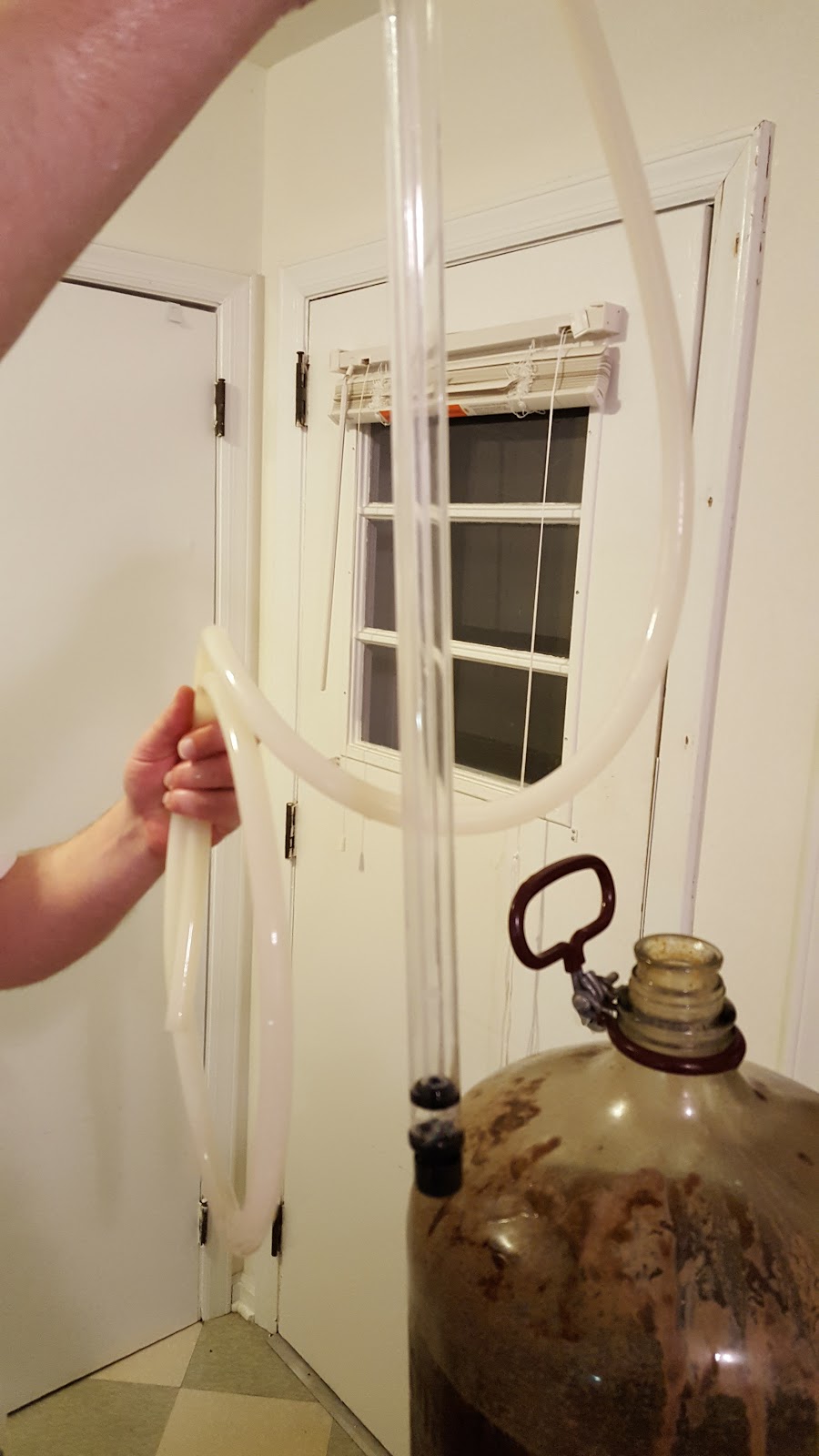
 Now we are ready to keg it.  We just siphon the beer from the carboy to the kegs.  We used two kegs because we were splitting this batch.


After we fill our kegs, we just need to hook the kegs up to some CO2 to pressurize it and then it is ready to drink!  We put the C02 at about 30 psi, put the keg on its side and rolled it for a few minutes.  Be careful here as it is easy to overpressurize the beer especially when the keg is only half full like ours were.