Monday, April 10, 2017

Brewing Beer - Berliner Weisse

I wanted to share beer brewing experiences, at least when the beer turns out to be good.   :)   This was one that a friend and I worked on on the end of 2016.  Kirk is the real expert here and so I learned a lot from this brew.  He asked me what I wanted to brew and I said can we brew a sour beer.   This is how we did it.

First we need to do a little prep work.  Keeping everything clean is super important.  Star San is a great sanitizer for surface sanitation.  The great thing about this product is you do not need rinse it off.  Just soak your equipmen or dip your supplies in a solution of this stuff and  you are good to go.


We also want to get rid chlorine and chloramine in our water.  So adding campden tablets to our water will take care of this.  


Next we need to get our water boiling to get it good and sterile.  This will be a 5 gallon batch of beer and we are going to go ahead and boil all 5 gallons.  Having a pot with a temperature gauge is very helpful.  Just don't watch while waiting for a pot to boil.  It will go much slower!


 Once we get a good boil we can pull the pot off the heat and add the extract.  For this beer we are adding 6 pounds of Munton's Plain wheat extract.  This extract is 55% wheat and 45% barley.


 Once the extract is added we need to stir to make sure it is dissolved well.  We also don't want it to  stick to the bottom and burn.


Finally we need to cool the wort to ~ 120 degrees Fahrenheit.  What makes this beer different than other beers is we have this extra souring step.  Normally we would boil some hops, cool, and pitch our yeast.  In this case we need to "sour" the beer.  A bacteria called Lactobacillus can be added to our wort and will start eating the sugars.  In this process it is souring the beer and giving the flavor we are looking for.  This bacteria likes to grow between 100 and 120 degrees F and so we need to cool our wort to this temperature.   We used a copper coil to get the temperature down.  Kirk had a little sump pump to help pump water through the coil and back into the sink.


Once the temperature is down to the correct place, we need to get some Lactobacillus into our wort.  This can be accomplished in a number of ways.  You can buy cultures.  A cheaper way is to buy some wheat grain and throw them into your wort.  Wheat naturally harbors Lactobacillus and is a great way to introduce Lactobacillus.  A couple hand fulls should be good.


Now we need to create an environment where Lactobacillus grows well and where "bad" bacteria cannot out compete the Lactobacillus.  We need to give the wort a cover since it will be sitting here for a few days.  Se-ram wrap works great.  Get a thick and tight covering over your wort.


We let the wort sit for 3-4 days at the correct temperature so it can sour.  We let it sit on the stove on the simmer setting the entire time and it kept the temperature perfect.  You can take a few taste samples at day 2-4 to get it to your desired sour level.  


After 3-4 days we can start the next part of the process.   First we need to remove all those wheat grains.   


Next we are going to do another boil.  Our beer is soured and we want to kill any other bad stuff that may be growing in our wort.  We also want to add hops.  Here are the hops we used.


After the hops boil, we cool the wort again with our cooling coil.


Once we are at the right temperature we are ready to move the wort to the fermentation carboy and pitch our yeast!

We make sure our carboy is sanitized.


 Then we move the wort over.  A funnel with a strainer is needed here to keep all the hop material out.


Now we pitch!   We just used yeast from white labs.


 Now its time for the yeast to do its thing.


After about 10 days we come back to see our beer!


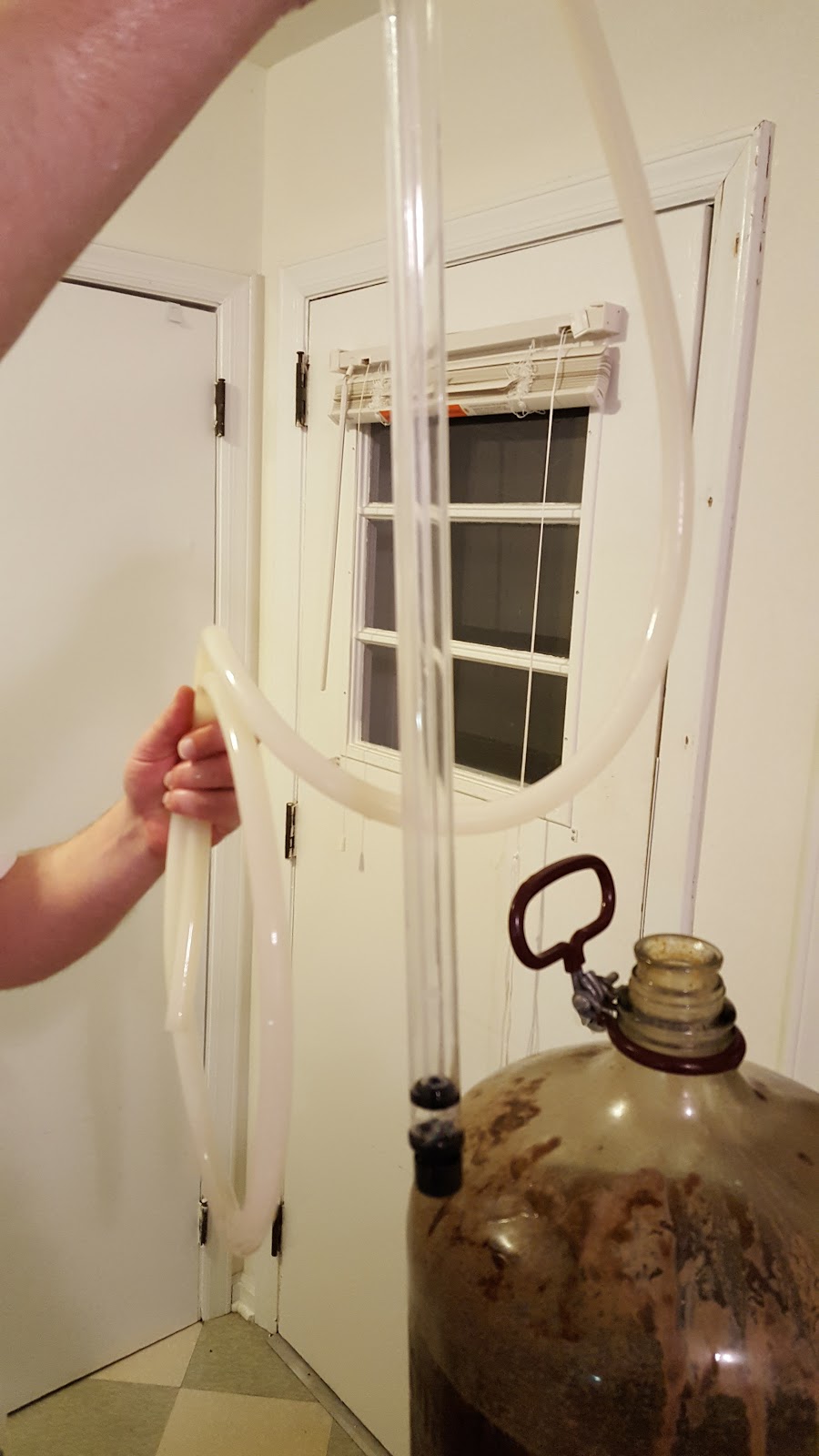
 Now we are ready to keg it.  We just siphon the beer from the carboy to the kegs.  We used two kegs because we were splitting this batch.


After we fill our kegs, we just need to hook the kegs up to some CO2 to pressurize it and then it is ready to drink!  We put the C02 at about 30 psi, put the keg on its side and rolled it for a few minutes.  Be careful here as it is easy to overpressurize the beer especially when the keg is only half full like ours were.


Monday, March 27, 2017

Science for kids - The Iodine Clock

Some of the best parts of my day are when I get to go to a school or organization and talk about science with kids.  Just the other week I went to Davis Drive Middle School with a colleague (Thanks Mandy!!) to talk about chemistry.   We visited an after school chemistry club and it was obvious these kids were passionate about science and chemistry.

We talked a lot about pH and how it can affect plants.  We also talked about how certain molecules can interfere with other molecules.  This is important in the plant world because certain nutrients can suppress or even increase uptake of other nutrients.  It is important in human health as well.  Many of us have taken medicine and heard from our doctors certain rules we need to apply while on the medicine.  For instance don't eat grapefruit while on this medicine because it can interfere.

So one experiment we did was to try to show how certain components in a solution can interact with other components in a solution.  It is a very visual experiment and done with household supplies.

The supplies you need are Vitamin C (1000 mg), Iodine (2%), Hydrogen Peroxide (3%), and liquid starch.


You will be making two separate solutions.

Solution 1 is a combination of the vitamin C and Iodine tincture in water.

Solution 1 - Step 1.  Mix 1000 mg of vitamin C in 60 mL of water.  The vitamin C we had is 500 mg tablets.  We crushed 2 tablets pretty easily and mixed the powder in water.  We had colored tablets which will work fine.  If you can find non-colored vitamin C that will work just great as well.


Solution 1 - Step 2:  Next add the Iodine to the Vitamin C and water.   You will add 5 mL of the Iodine to the solution.


At this point solution 1 is done!


Next we will make Solution 2 which is a combination of water, hydrogen peroxide, and liquid starch.  

Solution 2 - Step 1:  Add 15 mL of hydrogen peroxide to 60 mL of water.

Solution 2 - Step 2:  Add 5 mL of liquid starch to the water and hydrogen peroxide mixture.

We are now done with solution 2.


Once you have your two solutions, we can start the reaction.


Grab a new clear container and pour solution 1 and 2 together in the new container.  You can pour the new solution back and forth between empty containers a few times to be sure it is well mixed.


At first it will look like nothing is happening.


Over time (hence the clock), the solution will instantaneously turn dark blue-black!!


So what is going on?  Well when starch and iodine molecules mix you get a dark blue.  However we added some other things that interfere with this reaction.

One reaction that is going on is production of I2 molecules.  The hydrogen peroxide was added to the household iodine and it forms Iodine molecules.  When iodine meets starch it turns blue-black.  

+ 2I – (aq) + H2O2(aq) ->I2(aq) + 2H2O(l)

However we did not get a blue-black color immediately. This is because a second reaction was underway due to the addition of the Vitamin C powder.   The I2 produced from the hydrogen peroxide should react with the starch, but instead it immediately reacts with ascorbic acid (from the vitamin C tablets).  This prevents the I2 from reacting from the starch.  In essence it is shielding the I2 from the starch.

I2(aq) + C6H8O6(aq)-> 2H+ (aq) + 2I – (aq) + C6H6O6(aq)


Eventually the ascorbic acid is used up and there will be enough I2 react with the starch and get a color change.  This is a great example of how certain molecules can hinder other molecules.

It was a fun day at Davis Drive middle.   This reaction can be sped up or slowed down by certain variables as well.  We actually split into two groups.  One group used 60 ml of water for solution 1 and 2.  The other group only used 30 ml of water for each solution and we compared which reaction went the fastest.   What do you think?   If you want to experiment or read more at home here is a great resource:  http://www.greeningschools.org/docs/VitaminCClockReaction.pdf


Monday, March 13, 2017

The Arctic Apple - A GMO apple that does not brown

I have 3 kids and as many of you know getting them to eat the healthy stuff can be challenging.  If I give them a bag of M&Ms then they gobble them right up.  Giving them some broccoli can be a different story, at least with my 7 year old.   He is a very picky eater and even fruit can be a challenge to get him to eat.

At least one study shows that one thing to do to help kids eat fruit is to have it sliced.  You can find the abstract and more info here:  http://www.ajpmonline.org/article/S0749-3797(13)00105-0/fulltext

It's conclusions were:

"Sliced fruit is more appealing to children than whole fruit because it is easier and tidier to eat. This study applies the principle of convenience from behavioral economics and provides an example of a scalable, low-cost environmental change that promotes healthy eating and decreases waste."

I know my kids prefer sliced or cut up fruit.  Yet even that does not always solve the problem.  "Ewwww, that banana has a brown spot."   "Yuck, that apple is brown,"     I hear this type of talk with certain foods so I am a fan of anything that can help get my kids to eat healthy food.

Well when it comes to apples I might just get my wish.  There is a new apple in town that is being introduced in midwestern grocery stores called the Arctic apple.  Hopefully more introductions to other grocery stores will follow in the near future.  The Arctic apple is special in that it does not brown when sliced and exposed to air like other apples.  

This is a great story, yet for some this is not a happy story at all.  The reason is because the Arctic apple is a GMO.    Since the first mention of this apple there has been a lot of false information and fear about the apple.  Even Dr. Oz was throwing around his skepticism in 2015 when the apples were finally getting started.

Let's start by going over the science.  How does this apple work?  Many people stop at the word GMO.  Instead let's explore the science and see exactly what is going on with this apple and compare it to other DNA changes in the world that we don't really think twice about.

The first answer to this question is to investigate why apples turn brown in the first place.  When a fruit or vegetable such as an apple or potato are damaged (sliced), an enzyme called polyphenol oxidase is released.  This enzyme causes the browning we see.   There are many plants that will exhibit this color change effect from PPO including lettuce, mushrooms, and potatoes.

So if you can inhibit the production of PPO production, then you reduce the browning that occurs.  The Arctic apple does this through a GMO approach.  A question and answer from the Arctic Apple website states:


Hi there, and sorry for the delayed response!
The specific genes that stop Arctic® apples from turning brown come from apples. Apples have a small number of genes that control the production of polyphenol oxidase (PPO), the enzyme that initiates the browning reaction when an apple is bitten, sliced, or bruised. We insert apple PPO genes that make Arctic® apples produced less PPO, and therefore they don’t have enough PPO to turn brown."
http://www.okspecialtyfruits.com/how-we-introduce-the-nonbrowning-trait-in-arctic-apples/


What the Arctic apple team did was take some DNA sequences from other apples and get them into the Arctic apples plant genome.  You can see some of my previous posts to see how genes are inserted.  These sequences actually turn up the production of PPO to a very high level.   So how in the world does adding genes that increase PPO production actually decrease PPO and browning?  This sounds counter intuitive. Shouldn't increasing  PPO production actually make the apples brown even more?  That is a good question.  Well the world is an amazing place and we (plants and animals) have lots of feedback mechanisms to help control our genes.  One of these mechanisms is called gene silencing.   There are different forms of gene silencing, but in the case of Arctic apples by having such high expression of the PPO genes, it actually causes the plant to say "Whoa!  This is too much.  Shut it down Scotty!"

There is a nice graphic I found of this mechanism by Kevin Folta (and another great read on the arctic apple):

http://www.science20.com/kevin_m_folta/the_hard_science_behind_the_nonbrowning_arctic_apple-224898


Segment C shows what is happening at the molecular level in the Arctic apple.


The result is you get an apple that does not brown!

http://www.arcticapples.com/how-did-we-make-nonbrowning-apple/


If you are interested in diving into more science here is a science paper on reducing the browning in potatoes through inhibiting PPO in potato:  Reduced polyphenol oxidase gene expression and enzymatic browning in potato (Solanum tuberosum L.) with artificial microRNAs

Well that is the science behind the Arctic apple.  It is pretty neat stuff I think.  And in reality it was a very small change in the apples genome.    I know some still argue that it is unnatural to mess with genes even if it just one change.  I have a couple arguments to try and convince you otherwise.

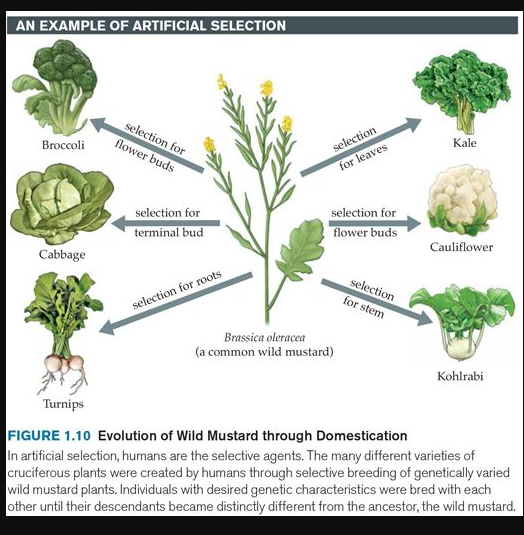
One of the best visuals I can give as a counter argument deals with some foods we all the time and never think twice about it.  These include broccoli, cauliflower, cabbage, and turnips among others.   These foods are not "natural" in the sense no one ever just discovered them in the wild.   Humans tinkered with a plant called Brassica oleracea.  Through breeding over years and years they selected for the best leaves of the wild mustard plant to get kale.   They selected for the flower buds to get broccoli and cauliflower.     How many changes to DNA sequences do you think were involved in this process?   Broccoli looks nothing like wild mustard because it was human made.  It is healthy and humans have been eating it for thousands of years.  In fact humans were figuring out how to make these mutations to get broccoli in the 6th century BC.  It made its way to America in the 1700s, but never gained great acceptance until the 1920s.  Wow, does this trend sound familiar?


Secondly, we are using gene silencing and other technologies that change how genes are expressed to help with human health too.  A company called  Ionis has many drugs in development that can help with some awful diseases.


Remember that PPO gene that causes browning in an apple.  What if there were a protein that causes a disease in humans and you could turn that gene off so you limit the protein production that causes the disease.   I would certainly use this to help ease the suffering of a loved one or even cure them.   Well one drug in development for Huntington's disease would do just this.

http://www.ionispharma.com/

Humans have been manipulating plant genes for thousands of years.  Our technology has just gotten much better and we can be more specific with those changes in both plants and humans.   When you breed and make something like broccoli with thousands of DNA changes it just goes on  the market.  When you make a couple gene changes with a GMO approach it gets tested for years!! for safety before entering the market.   I can't wait to get hold of an Arctic Apple.  Science is an amazing thing and I can't wait to see what the future holds.

Everything we talked about is summed up nicely in this infographic that the Arctic Apple team put together.


Add captionhttp://www.arcticapples.com/want-see-how-we-made-perfect-fruit-even-better/

Tuesday, February 28, 2017

Science for Kids: pH fun

I had the pleasure to go to Laurel Park Elementary school in Apex, NC  to have fun with acids and bases and talk about pH.  There are some fun activities you can do with acids and bases and most of these you can do at home too.

Liquid pH indicators - red cabbage juice

There is this great pH indicator that you can make yourself in the kitchen.   You can boil red cabbage or blend it to collect the juice.   I cheated a little and just bought some cabbage extract in powder form from Amazon.  Just add some powder to water and you have red cabbage juice the easy way.


 For this particular brand you add 1 scoop of powder per 100 mL of water.


Depending on the pH of a liquid you add to the cabbage juice, it will turn different colors.


So we took a few different liquids and added them in order to see a color and then use the color to get an estimated pH..


Liquid pH indicator - bromothymol blue

There is another indicator that is really neat.  It is called bromothymol blue.  When you add just a little bit to water it will be blue since the pH is around around 7 or above.  If you take a straw and blow into the solution it will slowly turn yellow.  The reason is that carbon dioxide from your breath reacts with the water and forms carbonic acid.  Pretty neat stuff!


A dab goes a long way!!


Just blow air into the liquid through a straw


pH indicator strips

Lastly we used pH indicator strips to measure pH.  I just bought these from amazon as well.


We paired the kids up and each pair had 5 tubes.  In these tubes were lemon juice, cherry pepsi, water, baking soda, and windex.    They used a strip for each tube to record the color, match the color to a pH and see if they could figure out what the liquid might be.


These activities are a great way to engage kids while you go over acids, bases, and pH.   It's just another way to make science make sense in a fun way.   Seeing kids getting excited while filling out a science worksheet makes for a good day.   I look forward to seeing what the future holds for these future scientists!


Monday, February 6, 2017

STEM champions - The Daniel Center for Math and Science

I have come to a realization that many kids love science, but sadly some just don't get lots of opportunity to see science in action.   So it is awesome when you stumble into Science, Technology, Engineering, and Math (STEM) outreach for those kids that might not have normally had such an opportunity.

The opportunity I recently had was through my work at Bayer CropScience.   Bayer has teamed up with a learning center in Raleigh called The Daniel Center for Math and Science.  The collaboration brings Bayer's "Making Science Make Sense" curriculum to the center for some fun science experiments once a month.     I have lived in the Raleigh area for years and had no idea about The Daniel Center.   However I was thoroughly impressed with the passion from those who run and volunteer at the center showed for the kids that were there.

The Daniel Center is a non profit organization seeking to help kids become more proficient in STEM subjects.   Their website says it best:

"There is a known gap in math and science education between American children, and children from many other industrialized nations. When at risk, and socio-economically disadvantaged children are examined as an isolated group, the gap is overwhelming. Our mission is to help children become more proficient in math, science and technology; and to prepare and motivate them to pursue a post-high school education. The Daniel Center for Math and Science is an after school and summer/track out program that seeks to narrow the education gap for at risk, and economically disadvantaged children. Our program consists of two components. The first is ages 5-12. This component exists within the framework of a licensed school age childcare facility. Our second component is our teen “Smart Is What’s Up!” program. When students age out of childcare, they transition into our teen programming, which focuses on academic tutoring, college-readiness, career exploration, and life skills. The Daniel Center introduces children to the immense opportunities in STEM-based careers through a curriculum that is activity driven, inquiry based, lively and fun."

http://www.danielcenter.org/

As I showed up I was greeted so warmly.   I immediately had help from two NC state students.  It seems the honor program at NC State volunteers all the time to help with snacks, cleaning tables, doing experiments, doing homework or anything else that is needed.   As I left the center that day three kids were cuddled up to one NC State student going over math problems.   There is nothing so heart warming as watching an impressionable child enjoying their time learning about science and math.   Kudos to these college kids for not only working towards their degree but already making a huge difference in our society.

As for our stay, we had 3 other awesome Bayer volunteers engage the kids about DNA.   A big thanks to Durba, Ashley, and Casey!    I was impressed when the kids gave a very nice description of DNA.    This just shows the quality of the program at The Daniel Center.    We talked about DNA and then had our hands-on where we made DNA with twizzlers and gummy bears.   Then we extracted DNA from bananas.   If you are curious about these experiments and want to try them at home you can find detailed instructions in an earlier blog post.  On a personal note, I love running these experiments if any local teachers want help.  I know I am already looking forward Laurel Parks STEM night coming up soon.

For me it is important to show that science is fun while still teaching a lesson.    In a world where many people don't even think food (like bananas) have DNA we need to proactively reach our kids with more STEM activities.    These learning are crucial for our future leaders.  Places like The Daniel Center are reinforcing fndamenatal principles for kids that will be our next leaders.  What our future leaders learn now will influence future decisions that affect our world.   Our leaders need lots of skills, but a science and math background is one that should not be overlooked.

I am sure there are plenty of places like The Daniel Center around the country and even the world.   Most of these places need support which can be given in a number of ways including volunteering your time or even financial help.    Any help you give to an organization like this really will make a difference for these kiddos.  This extra investment from places like The Daniel Center is above and beyond what they get in schools and that time spent with these kids is also an investment in our world's future.  

Here was some of our fun!