Monday, November 5, 2018

Travel to St. Lucia: An HDR photo tour

My wife and I recently got to take a trip to St. Lucia, kid free!!  Some huge thanks to my dad and mother-in-law for making that happen!  As we planned a trip, I really did not know much about St.Lucia except that it was an island and it looked pretty.  However I was excited to have the opportunity to explore it in more depth.  So for those of you looking for a travel destination I hope this helps convince you that is this island is worth visiting!  I enjoy photography, so I tied to have some fun with HDR (high dynamic range) pictures of of St. Lucia travels, so this is a tour of the island HDR style.

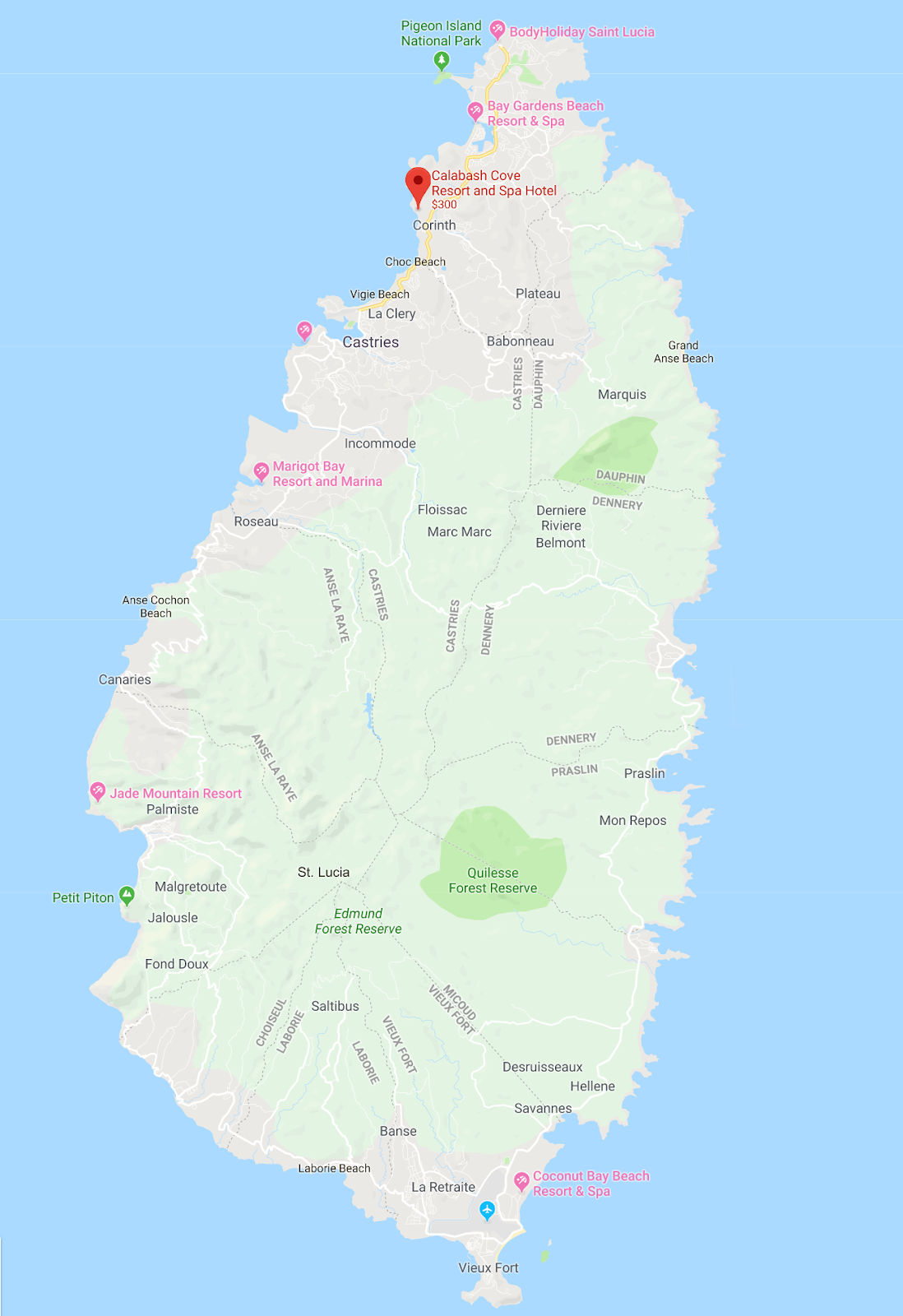
The island is located about 3 hours from Miami by plane.  Here is a map to get your bearings.


We have been to large resorts like Sandals in and we wanted to try something a little smaller and intimate this time.  We decided on Calabash Cove Resort and Spa Hotel.    This small resort only had 4-5 other couples the entire time we were there, so you really got to know the staff and meet some really awesome people while hanging out at the pool bar.  I even met a weather meteorologist for the local TV station in Mississippi.  We went in October which is the rainy season and technically still in hurricane season.  The islands are a little south so while hurricane can hit, it is more rare than some of the other islands.  As for the rainy season, it did rain while we where there.  One day it rained all day while the other days had showers, but it never bothered us.  There is less tourism on the island during the rainy season, so I actually preferred this time. 

When you fly into St. Lucia you will  land in the south of the island while our resort and many others are located to the north of the island.  We had a driver pick us up and it was about an hour and half drive.   We came in at night so did not get to see so much, but most of the island is a rain forest and you will first hear how alive it is.  Tree frogs and insects sang the entire way to the resort.

You will see the airport at the bottom and our resort location in the northwest side of the island.


Calabash Cove was at Rodney Bay and the view was amazing.  Since we were in a bay the water was so smooth!   And of course they were parts of the ocean that are turquoise blue!  We had a view of rainbows and sunsets almost every day from our hotel.


The landscaping on the resort was beautiful !    Here were just some of beautiful flowers right at our rooms.


St. Lucia has a crazy history.  The French were the first European settlers, but the British later took control of the island.  However over the years they two countries fought each other for the island FOURTEEN times with the each gaining control seven times.  So the island has a mix of both cultures.  For instance,  St. Lucians drive on left like the British, English is the official language, but the St. Lucians also speak Creole-French.

We mostly stayed on the resort and ate great food, drank great drinks, kayaked in the Caribbean and relaxed.   Although one day we did go out and try to take in a little of the island.

Our trip involved taking a trip down the West Side of the island.  The first stop was through Castries, the capital of St. Lucia.     Here is overlook of the city.  This is also where cruise ships dock for a day and we saw 1 of those small cities dock while we where there.

Our resort was located near that tiny round island in the distance in the middle of the bay.  We tried to kayak to it from our hotel but did not quite make it.  :)

We took a quick stop overlooking Marigot Bay which is where Dr. Doolittle was filmed.  There was a rainbow that I thought we were going to be able to touch because it was so close to us.


As we continued to travel South, we passed many banana plantations.  Banana are one of St Lucia's main exports.  The island switched to from sugarcane to banana although St. Lucia still has its own brands of rum.  If you want St. Lucian rum you can find a lot of it.   Our driver said give Bounty to your mother-in-law and buy Admiral Rodney for yourself.

In my opinion the real jewel of St Lucia is the Pitons.  Since St. Lucia is a volcanic island there are some fun volcanic formations.  The Pitons were a volcano vent that was plugged with magma.  The soil around the plug eroded away leaving these steep magma mountains.  There are two of them on the island called Gros Piton and Petit Piton.  You can hike up them, but we did not have enough time.  It is a very steep climb and takes about 2.5 hours to get to the top.


A beautiful view of Soufriere and both Pitons!


Nestled below the Pitons is the city of Soufriere.  The name means Sulfur in the air.  I love that name!  The name is quite literal as you will see in a bit.

As you get near the Pitons there is a botanical garden to visit.  Besides some beautiful plants, you will find a waterfall called the Diamond Falls.   This garden estate also has mineral water baths you can bathe in if you wish.

Diamond falls - here was a long exposure with small aperture.


Bird of Paradise - My favorite flower!


The water running through the gardens is gray from the volcanic minerals.


And finally we saw the "drive in volcano" near Soufriere.    The first thing you will notice is the smell of sulfur.   The best thing about this area is the heated baths you can take a dip after giving yourself a mud bath.  The locals say the mud bath take 15 years away from appearance.   I don't buy that, but it was a very cool experience.  If you go to St. Lucia the mud bath is not to be missed.

Smell that sulfur!   It is strong!


The water feels so good!!

So if you are looking for a Caribbean island to visit, St. Lucia should be at the top of your list.

Monday, October 8, 2018

The Public Necessity of PLAY!


Sometimes it is easy to lose sight of how much local companies give back to their communities. Usually products and new technologies make the big headlines. However in the background, companies like the one I work for are giving back to the communities they share space with.  BASF is a sponsor for the Marbles Kids Museum in Raleigh, NC and from this connection I was able to attend a recent luncheon. This luncheon was called the Marbles Big Idea Forum and the topic was on PLAY.

Here we are ready to learn about PLAY.


The topic of play is a perfect one to learn about at a museum devoted to letting kids have fun. My family has a yearly membership, so I can say with confidence that adults can have plenty of fun too in this museum. Yet sometimes we forget the importance of play and the talk we were about to listen to enphasized why play is so important no matter our age. Dr. Stuart Brown who is the founder of the National Institute for Play and even wrote a book on play gave the inspirational talk. This was a talk that I wish everyone could see, so I wanted to distill it down into a few points that I took away.

Humans (and animals) all are built to play.

It is interesting to know that we all have the wiring to play with each other even across species. Play is like a universal language. We of course play as humans and we have all seen kids on a playground having a great time. Animals are the same way as there is nothing cuter that watching two kittens play together.   We also play across species as humans play with animals very fequently. Who is getting the most enjoyment out using a laser pointer to play with a cat. The cat or the human? Even animals can play across species.  Dr. Brown shared a story about a polar bear encountering a sled dogs. He was a photographer for National Geographic and took pictures of the entire encounter. While the polar bear originally looked as though it was the predator looking for food, the dog went into a playful position. What happened next is amazing.


https://www.flickr.com/photos/c_a_bray/2069630876


The concept of a bear and dog playing together in the wild seem so unrealistic that I found the question of its validity on snopes. https://www.snopes.com/fact-check/unusual-encounter/

You can also watch a description of the photos on youtube.


The other thing that caused a lot of reflection for me is that not only are we build to play, but we play throughout our lives. I loved the analogy of a lab and a wolf and their play habits compared with a human’s play habits. A wolf pup and a lab pup play very similarly with lots of rough housing and nipping tails. The wolf grows up and it is nothing but business and survival. The lab grows up and still plays ball till the day it dies.  Humans are the same as the lab. We play as kids, but as we grow up we still play and have the capacity to play till the day we die. I remember my older grandparents being some of the funnest people I played with as a kid.  I wonder if “we are all still kids at heart” came from this truth.

This concept of retaining juvenile features into adulthood is called neoteny. There is a great word of the day!

Humans and animals all play in different ways.


There is an amazing amount of research that has been done on play! Dr. Stuart breaks play into 7 types. All of this info and the pictues to help visulize the play types is taken straight from the National Institute of Play. If you find it interesting there is much more there! http://www.nifplay.org/science/pattern-play/


Attunement Play


Body Play and Movement


Object Play


Social Play


Imaginative and Pretend Play


Storytelling-Narrative Play


Creative Play


One note was that we sometimes see children being rough during social play. Just like anything this can get out of hand, but many times it may be stopped prematurely. However if two kids are pinning each other down but both smiling, this is a positive mode of play.

What is your play style? I thnk objects is mine. I love playing sports which use balls. I also still have fun playing with some legos when I get a chance! And if there are objects in business meeting, I will instinctivly grab it to play with.


There are consequences when we do not play


Play is fun, but what happens when we don’t play. Is play deprivation real? Dr. Stuart led an interesting career in he studied play along with murderers. He mentioned this very quickly in in his seminar, but I found an interview that delves into this topic further. The entire read is really good. http://www.journalofplay.org/sites/www.journalofplay.org/files/pdf-articles/1-4-interview-importance-ofplay-stuart-brown.pdf


Here Is just one excerpt from that article.


Surely these are extreme cases of what happens when someone is deprived of play their entire lives. However it can affect all of us. Here was one slide from the talk that summarizes the effect play deprivation can have on all of us including absence of empathy, rigidity, Interpersonal conflict, joylessness, addictions, diminished curiosity, and workaholism.


The summary of this seminar is quite easy to distill. We are meant to play and we all have our preferences on how we play. When we do not play it can have serious consequences to ourselves, to those around us and even society. I really buy into all of this. When we play we become engaged in a way that is non-threatening. Worries go away and we connect with those we are playing with. Applying the learnings is much more difficult. Someone at our lunch even asked how can you bring play into such serious business environment. The answer is that you still can, but you have to make an effort to do this and it needs to be supported within the company. The value it creates is sometimes hard to explain when effencicy and bottom line are goals. Yet I always believe that when employees are happy they are much more productive. I think something I will think about more is what is the play style of those around me instead of thinking that my style is the only one.

Dr. Stuart started off by saying Marbles kids museum is the Fort Knox of Raleigh. At first I did not truly understand what he was saying, but now I do. That museum will weather all the changes of future progress and still be standing in the end like just like a well built fort. It will still be standing because it is a human necessity to ensure play is encouraged so that we will all benefit.

Monday, September 24, 2018

Cub Scouts Fun: Popcorn Bag Tower Competition

I have been in scouts for a long time.  Those years have included my time as a cubscout, a boyscout, a parent, an assistant den leadear, and a den leader.    My time in scouts has inspired me to teach kids along with my own two boys what scouts taught me.  There are so many great ideals embedded within this program as well as the fact it gets my kids outdoors to take in the beauty of our Earth.  The one things that remains constant is that scouts relies on volunteers and when needs arise I have been happy to help where I can.  So this was the first year I have put on the Cubmaster hat.

Now if there are other Cubmasters out there, I am guessing you felt as lost as I did when trying to understand what we are supposed to do.   Yeah the 3 hours!! of online training might have helped a tiny bit (at least for my style of learning) and the retiring scoutmaster was and still is an unbelievable mentor.  So once I jumped in and also learned more from the den leaders, the assistant cubmaster, and others who have been in scouts the role started to become a little more comfortable.

One of the roles of the Cubmaster is to lead the Pack meeting.  The Pack meeting is where everyone from the entire pack gets together once a month.   During this meeting, our Pack 200 of 40-60 boys, their parents and all the scout leaders get together in the gymnasium of the First United Methodist Church in Cary, NC.   Here is where we celebrates achievements together across our dens which have boys in the age range of 1st to 5th grade.

I think the Pack meeting is one of the biggest challenges of being a Cubmaster because it is not always easy to hold the attention of this many boys across that age gap.   I have to say the scouting program is full of resources and they even have plans for each pack meeting of the year.  I personally do not always find every plans to fit my personal style, but there are definately pieces of them that I find useful. 

This link is a library of all the plans.  Even if you are not into scouts, but work with kids then you may find some nuggets here:  https://www.scouting.org/programs/cub-scouts/pack-meeting-resources/pack-meeting-plans/

There are also lots of resources on the web from other packs since these meetings have been going on for years and years across the country.  Since I am grabbing information from so many people and resources, I wanted to give back a little and share too.

The last pack meeting I ran was the kickoff meeting for the year.  It is also a tough one because it is a time we share information for our one and only fundraiser of popcorn sales.  So how do you couple popcorn selling information with some fun for the boys?  The answer was having a compitition between the dens to see who could build the tallest tower out of theater popcorn bags.  For this activity you only needed two supplies

1.  Popcorn bags - 25 per den of 5-8 boys
2.  One roll of  yellow masking tape for each den - Represents the butter for your popcorn


I found the popcorn bags on amazon:   https://www.amazon.com/gp/product/B01I0A9GV0/ref=oh_aui_detailpage_o09_s00?ie=UTF8&psc=1


The objective is to use the bags and tape in anyway you want to build a self standing tower.  The only rule was the tower had to start on the ground, had to be stand by itself, and only the bags and tape could be used.  We gave the dens 15 minutes to work on the activity before seeing which den had the highest tower.

This activity turned out pretty well.  I was not sure how it would turn out but the kids, the den leaders and some of the parents really got into it.  If you ever need a popcorn theme activity or if you just need to have a fun teambuilding activity try this one out.

Enjoy!


Monday, August 27, 2018

STEM Outreach with BASF: Exploring Chemistry - Clean Water and pH

It has been a busy summer, but I finally got back into a classroom to have fun doing science with middle schoolers.  It has only been a few weeks since I transitioned from Bayer to my new employer BASF as part of a large divestement.   Yet in that small amount of time, it did not take long at all to see that BASF is also a strong agvocate in our community.   As a large BASF group we all took half a day to head over to East Wake Middle School in North Carolina to meet a bunch of 8th graders.

Game faces were on as a bunch of enthusiastic folks from BASF wore their green shirts with pride.


Some of have been doing outreach together for a long time so you gotta take advantage of selfie moments.


Once we loaded up it was a short trip to East Wake to meet the students.  We split up into groups and headed to our classes where my team ended up meeting Ms. Shores class.   What a great opportunity it was to take some time out of our busy day and work with students and to work closely with my BASF colleagues Courtney, Paulette, Casey, and Yasmin.  This is an account of my expereince with one class, but there were similar stories going on across many other classroms with other teams.

We first had to safety up.  And we would not look like scientists without our lab coat, glasses, and gloves!


Our first experiment was on pH.   We used red cabbage juice as a pH indicator which I have shown before in a previous post.  If you are interested in more details on pH experiments here is the link:  https://atransgenicworld.blogspot.com/2017/02/science-for-kids-ph-fun.html

The last time I used cabbage juice as a visual indicator of pH I just used some powder extract you can buy on amazon.    The organizers of our group went an extra mile and actually made the cabbage juice indicator the night before.   So if you want to make you own, here are the instructions.  Instructions are courtesy of BASF materials.


After explaining a little about pH we tired all kinds of stuff to see if it was acidic or basic.


Next up we talked about water and they all agreed clean water is super important.   We showed that water can have different types of contaminants.  Soil, sand, and dirt make water dirty, but so do other contaminants like  heavy metals or other chemicals.   We had a tube of water with sand and used food coloring to show other contaminants.   This dirty water definitely needed cleaning up.  First it went through just a regular filter and everyone's hypothesis that the filter would just catch the sand was correct.  The water no longer had dirt in it but it was still colored from the food coloring. 

First we added the water to just a paper filter.

The next thing we learned was that activated charcoal is a material that can help clean up water.  Everyone had their dirty water with dirt and food coloring to try and clean up again.  They put it through a paper filter again, but this time it also passed through some activated charcoal that we had added to the top of the filter.   I heard a few gasps when the water really did come out clear and clean as oppsed to dirty and red from the food coloring.


Lastly we just had a chance to talk.  Each of us from BASF joined 4-5 students and had about 10 minutes to just talk.  Of course the topic of video games did come up and most of them did indeed play Fortnite.  Maybe I gained a little more respect when they learned I like to play Fortnite too.   But I also heard such ambition and drive from this group.  One young lady wanted to be a Youtuber.  When I asked how many subscribers she had, she reported it was over 1000!!  I told her I barely get 5 likes on my instagram pictures!   They are so talented!  There were two that wanted to be marine biologists, 2 who wanted be a doctor, a couple that wanted to soccer players, one that wanted to be a lawyer, and other aspirations  And of course some who did not know which is OK too.   I did not even know what I was going to be and more importantly really like until I got my second job after college. 

Whatg a great day.   Thanks to the teachers, to the school, and to BASF for organizing this day.  I encourage all of you to pour your knowledge and passion on a subject into this generation whenever you get the chance.  They listen, they question and they fill you with hope for our future.

Monday, July 30, 2018

A Summer of Planets: Jupiter, Saturn and Mars

I really could call July 2018 the summer of clouds.  Here in Cary, NC this July has been full of humidity, storms, and clouds.   Yet, when the clouds have parted the July sky has housed wonderful views of the planets.   In fact Jupiter, Saturn, and Mars were all lined up at the same time across the sky to view late into the night.

I was able to get my scope out this July literally in between storms and get a quick picture of each planet.  Due to high humidity and clouds rolling in it was still not the best viewing.   However Mars is at opposition in July.  This means the Sun, Mars and Earth form a straight line with the Earth in the middle.  This event is when Mars is the closest the Earth and when it also will look the brightest.  In fact Mars is the fourth brightest object in the night sky now with only the Sun, Moon and Venus outshining it.  A Mars opposition only occurs every two years so i did not want to miss this one.

The pictures I took follow the same capture and processing steps as shown in previous blog entries.  The only difference is that I used a DSLR camera to record the videos instead on the webcam type camera.  My webcam camera is only black and white and while it can give crisper images, the DSLR shows color.  Therefore these images pull in some of the color of the planets.

The equipment and software used are:

Celestron EdgeHD 8
Celestron Edge AVX Mount
Televue 2.5X Powermate
Nikon D5300
BackyardNikon, Autostakkert!3,  Registax6

Mars

First up is Mars.  Even though it closest to the Earth right now, it is still a small little object for my  scope.  This picture picks up little detail other than the planet is red. :)   If you really look at the top of the planet you can pick out a whitish/less red area.  This is one of the polar caps.  Under the polar cap you can make out a little of the darker region of the surface.   Mars just went through a global dust storm a lot of surface detail is lost even when looking under a bigger scope.


Jupiter

I missed the red spot this night, but the banding is still beautiful.  Here are two separate processing attempts.


Saturn

By the time I got to Saturn the viewing conditions were getting worse, but you can at least see it has rings!


Hopefully I can follow up with another post showing these again.  I never get tired of looking at these majestic planets and seeing how they change each time you view them.

Monday, July 2, 2018

Spotlight on "Seeds of Science": How a mind was changed on GMOs


Have you ever wondered why it is so hard to change someone's mind even when you give facts that should make the decision easy?  Maybe even looking back you realize how many times you have not changed your own mind easily on certain topics even when someone presents a logical and fact driven argument. 

My wife and I have had some great debates over acupuncture.  I present to her all this information and science on why I think acupuncture is a hoax.   She presents all this information on why it is helpful.  I don't believe anything she shows me and she ignores my  arguments while making her next next appointment.  In the end neither one of us changes our minds.   In this example we have both succumbed to confirmation bias.  We both formed a strong belief and bias all of our arguments to finding information to support our views.   This is called confirmation bias.  Once we form a belief it becomes part of our identity and changing who we are are is much easier said than done. 

Confirmation bias is real and one that will take advantage of all of us at some point.  Taken from Wikipedia the definition of confirmation bias is "the tendency to search for, interpret, favor, and recall information in a way that confirms one's preexisting beliefs or hypotheses.[1] It is a type of cognitive bias and a systematic error of inductive reasoning. People display this bias when they gather or remember information selectively, or when they interpret it in a biased way. The effect is stronger for emotionally charged issues and for deeply entrenched beliefs."

Here are some great quotes across history that show confirmation bias is not a new concept:

“What the human being is best at doing is interpreting all new information so that their prior conclusions remain intact.”


— Warren Buffett

“The human understanding when it has once adopted an opinion draws all things else to support and agree with it. And though there be a greater number and weight of instances to be found on the other side, yet these it either neglects and despises, or else by some distinction sets aside and rejects.”

— Francis Bacon

“Beliefs can survive potent logical or empirical challenges. They can survive and even be bolstered by evidence that most uncommitted observers would agree logically demands some weakening of such beliefs. They can even survive the destruction of their original evidential bases.”

— Lee Ross and Craig Anderson

“One of the biggest problems with the world today is that we have large groups of people who will accept whatever they hear on the grapevine, just because it suits their worldview—not because it is actually true or because they have evidence to support it. The striking thing is that it would not take much effort to establish validity in most of these cases… but people prefer reassurance to research.”

— Neil deGrasse Tyson

“The eye sees only what the mind is prepared to comprehend.”

— Robertson Davies


Confirmation bias is no joke.  I have fallen prey to it many times and it is a bully that prevents us from changing our mind.   I have had countless debates with people who have already made up their mind that GMOs are bad.  In the end I can convince very few of the merits of GMOs with the facts alone.  As a scientist I love the facts, but over the years I have come to realize facts are only part of the equation to convince someone to change their mind.  There has to be some other connection, usually an emotional connection that can enable us to pull off our blinders and look equally and fairly at both sides of an issue.

That is why today I am not going to spout facts, but instead spotlight a book I just picked up called Seeds of Science by Mark Lynas.  I am not going to pull much from the book, but instead encourage everyone to pick it up and give it a read.   It was just released in June of 2018.   The only part I will focus on is some pages from Chapter 2 which is entitled "Seeds of Science:  How I Changed My Mind."


Mark Lynas was a strong anti-GMO advocate and led efforts to go into GM fields and destroy them.   You could almost call him the father of the Anti-GMO movement.  We are not talking about someone who just thinks GMOs are bad, we are talking about someone who was willing to break the law in destructive tirades to get a point across.

As Mark was protesting GMOS, he was also becoming a strong believer in climate change.  He began to dig into the science as well as use its arguments because the science supported his view on the climate.  (Confirmation bias at its finest!!).  As Mark says, "the environmental and scientific communities were closely aligned on the issue."    He started looking at the facts and digging into the data.  It was this emotional connection to the environment and then a realization that science is just more than just one article that started to make Mark think.  

There is an excerpt I love in the book that in my mind defines when Mark came to the realization of what scince really is and why we can trust in it.  

Mark says, " When sifting through contradictory material, I learned to trust my intuition as much as anything, and to understand that single papers advancing unlikely conclusions should not be taken at face value on their own.  I began to see that scientific knowledge is cumulative: it is built up slowly like a house made of bricks.   Sometimes individual bricks need to be relaid or taken out and replaced altogether, but overall the wall generally continues to rise. Only rarely does it get entirely demolished and rebuilt thanks to a paradigm-changing discovery such as plate tectonics or evolution by natural selection.  Accordingly the vast majority of those who claimed, Galileo-style, to have overturned a century of scientific research were mostly cranks."

As Mark started to see the power of science he also started to question his views on GMOs.  There are many more details in the story that make a great read, but finally in 2013 at the Oxford Farming Conference Mark addressed a crowd of farmers with a big statement.

"My lords, ladies and gentlemen.  I wanted to start with some apologies.   For the record, here and upfront, I apologize for having spent several years ripping up GM crops.  I am also sorry that I helped start the anti-GM movement back in the mid-1990s, and that I thereby assisted in demonstrating an important technological option which can be used to benefit the environment.  As an environmentalist, and someone who believes that everyone in this world has a right to a healthy and nutritious diet of their choosing, I could not have chosen a more counter-productive path.  I now regret it completely." 

You can also see the video and read the blog entry from 2013:  http://www.marklynas.org/2013/01/lecture-to-oxford-farming-conference-3-january-2013/

Even after all these years, I am still amazed when I read or hear this.  I am also encouraged.   It is hard enough for any of us to change our minds, and even harder to apologize when you are on such a stage, yet he had the courage to do it.   

There is so much more in this book, but for Mark the seeds that started to change his mind were not from the facts on the safety of GMOs at the start.  They were born from the strong emotions he had for the environment that spilled over into how he thought about GMOs.  When making those arguments for the environment he could use the science because the science conformed to his beliefs.  If he could use science for one, how could he not use it for another topic?  Mark is an example of overcoming confirmation bias.  It took years to see it for what it was, but the story is that it can be done once we realize and understand confirmation bias.

Any technology is just a tool and all tools need to be used responsibly.  The beauty of the world is that we all look at issues through a different lens.  Those lens ensure a checks and balance system so that we do understand an issue from all angles.   It is when we challenge and then concede or challenge and the other side concedes based on sound evidence that we advance as a civilization and do not waste time in gridlock.  


Monday, June 11, 2018

The Beauty of the Moon: The Tycho Crater

This post is purely to share the beauty that is around us.  I can spend hours just looking at the moon in a scope and it never gets old.  This is an HDR picture of the moon I took recently which is 3 pictures of the moon stacked together.   I broke out my bigger telescope to get more detail of that beautiful lunar surface.  

Scope:  Celestron Edge 8 HD 
Camera:  Nikon 5300
Mount:  Celeston AVX
Processing Software:  Affinity Photo

It was still a little light in the sky when I took the image and that is why the background is still blue instead of black.  


If you look towards the bottom right of the moon there is one crater that stands out.  It is one of the brightest craters we see This is Tycho Crater.  It is 85 km in diameters and 4.8 km deep.   The crater is 108 million years old, making it a fairly young crate relatively speaking.  In the center of the crater is a peak complex that itself stands 1.6 km above the crater floor.   You can just make out the speck of

Here is a zoomed in image of the Tycho Crater.  You can just make out the raised peak in the center of the crater.


Monday, June 4, 2018

Getting a picture of Jupiter: Firecapture, Autostakkert!, and Registax

I have put a picture of Jupiter up before in a previous entry, but this time I wanted to go over the software I use to get a final picture.  It was an excuse to finally take my scope out again.  I have to admit that when I took these over this past weekend the seeing was not great.  Clouds were moving in and out, and the atmosphere was not supporting crisp pictures.  However, I did recover a picture even thought it is not of great quality.

This guide is just one one way to get a picture of a plant.   There are many methods and programs that can give the same end result.


Equipment:  

Scope: Celestron Edge 8 HD

Camera:  I used a webcam called an ASI120MM to take the movie that would ultimately make the final picture.

Magnification:  I used a Televue 2.5X Powermate to add just a little bit of magnification to the prime focus.

Mount:  My scope is attached to a Celestron AVX Mount.

Here is the setup:


Step 1:    Capture a movie of the planet with Firecapture

For planetary imaging we can can take a small movie and then stack the best frames from the movie to create the image.

The software I like the best if FireCapture to create the movie.   You can download the software for free.

http://www.firecapture.de/

Just hook your camera up to your computer and chose the camera you will use.  My ASI120 is made by ZWO so I choose the ZWO button.  You will probably need to install your camera drivers before using firecapture


Once you choose your camera and have your scope pointed to a focused Jupiter you just need to tell FireCapture to start recording.   FireCapture has a button with all the planers to the left.  Just pick the planet you are imaging.   Once that is done hit the play button to record.  I usually record about a 30 second video, but you can do more or less.


After you have a few videos that you like your scope time is done.  Now it is time to process the movies in a picture.


Step 2:  Stack frames from the movie with Autoskakkert!

There are lots of programs that you can use to stack frames, but I like to start with Autostakkert!

https://www.autostakkert.com/wp/download/

First hit OPEN and add your movie.  You will see he first frame of the movie appear in the second box.


Next hit the Analyze button.  This will show you a graph of how  many quality frames vs not so quality frames the software thinks are in your movie.    From this graph you can enter in the green/red boxes how many frames or the the percentage of frames you want to stack.  Based on my graph I am only going to use about 50% of the frames.  50% was already the default when I opened the software.


Once your have the number of frames you will use you need to place the AP grid.  These are points that that the program will use to make sure frames align.  I usually chose 24 as the AP size and then hit the "place AP grid" button.


Finally hit the STACK button and your  image is created in the output folder.


That is my final picture but we can use another free program to sharpen it a little. 

Step 3:  Sharpen Image with Registax

The next program we will use is Registax6.

https://www.astronomie.be/registax/

 Just open your image in Registax which will look like this:


In Registax there is a "wavelet" tab.  You can move those sliders and then hit the "do all" button to sharpen your image.   I find this a little bit of trial and error so keep playing around.

I finally finished adjusting and saved the final picture.


Just to show that Registax does make a difference, here is the side by side comparison.  The left image is after the stack in Autostakkert! and the second image took the stacked image and applied some post-processing in Registax6.  Those bands came to life a little more.